

Written by

You're already on LinkedIn. You post occasionally, you engage here and there, but something isn't clicking yet. The reach isn't growing, the conversations aren't happening, and you're not quite sure what separates the profiles that command attention from the ones that just exist.
The answer is often right in front of you: the people already doing it well.
We've used ChatGPT to analyze and evaluate Brazilian leaders on LinkedIn based on their engagement, thought leadership, and impact, delivering curated insights that can inspire your own profile glow-up.
Whether you're a founder, a senior leader, or an ambitious professional ready to take your LinkedIn presence seriously, this list is your cheat sheet.
If you want to start posting like these leaders without the time-consuming manual effort, you can start your free trial with Will, the AI assistant that turns your ideas into high-impact LinkedIn content directly via WhatsApp.
Cristina Junqueira – Co-Founder And CGO, Nubank
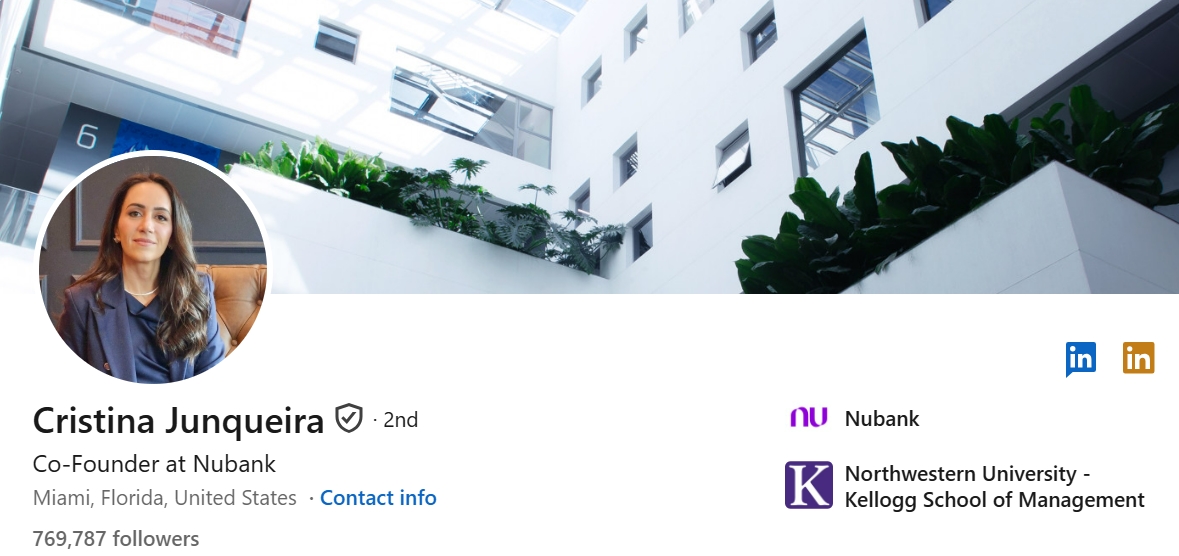
Cristina Junqueira grew up in Rio de Janeiro as the eldest of four sisters and saw a banking system that felt stuck in the past.
She chose to leave a comfortable career at a traditional bank because she felt she was failing by "making rich people richer" and could not see a future in an environment without women in leadership.
Today, she stands as one of the most visible female founders in Latin America, having turned that initial outrage into a purple revolution.
About Nubank
Nubank serves over 100 million customers across Brazil, Mexico, and Colombia. It changed the financial landscape by removing fees and simplifying the banking experience through technology.
LinkedIn Content Strategy Analysis
Who should follow Cristina: Fintech executives, investors tracking Latin America, women in leadership, entrepreneurs, and anyone interested in how challenger banks scale globally.
Core Value Proposition: As co-founder of Nubank, Cristina uses LinkedIn to narrate the company's global growth story while also speaking openly about her identity as a woman leader in finance. She balances institutional announcements with personal moments in a way few Brazilian executives manage.
Key Themes & Topics
- Nubank's Global Ambitions - Her dominant content thread. Major regulatory milestones and market expansions are framed as proof of a thesis, not just press releases:
- OCC approval for Nubank, N.A. in the United States
- Application for a US national bank charter
- Nu becoming the largest private financial institution in Latin America
- Brand Repositioning and Product Vision - Several posts cover how Nu is evolving its design language and AI-driven strategy, connecting product decisions to long-term global brand building.
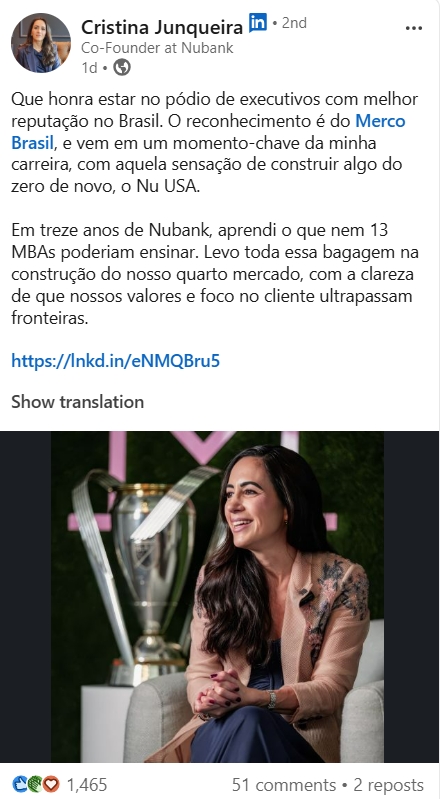
- Women in Leadership - Her most viral content lives here. Posts around her magazine cover photo taken three days before giving birth went significantly beyond anything else in her recent feed, generating over 11,700 reactions. She speaks about visibility, representation, and occupying spaces without apology.
- Talent and Culture - Internship program announcements, new executive arrivals (notably the welcome post for Ethan from Stripe), and reflections on learning and excellence at Nu.
Format and Presentation Style
Cristina writes in both Portuguese and English depending on the subject, with bilingual fluency that signals her audience is genuinely global. Posts are conversational but precise. She rarely uses numbered lists; instead she writes in short paragraphs with a strong opening hook. Personal disclosures are deployed with intention, not oversharing.
Engagement Strategy
Personal content dramatically outperforms institutional announcements in raw reaction counts, but institutional posts often generate more reposts, suggesting different audience behaviors. She does not rely on hashtags. She occasionally edits posts after publishing, indicating an active relationship with her own content.
Performance Indicators
Reactions range from roughly 900 to 11,700+. Her best recent performing post was the personal story about a magazine cover shot three days before childbirth, becoming the first visibly pregnant woman on that cover. It generated 11,739 reactions and 196 reposts. Institutional posts about the US banking charter and national bank approval reached 3,000 to 5,600 reactions, showing her professional content also performs well above average.
Overall Strategy Summary
Cristina runs one of the most effective executive LinkedIn accounts in Brazil precisely because she refuses to choose between personal and professional. The personal posts amplify her credibility for the business posts, and the business posts give her personal content real weight. The result is a feed that feels human, high-stakes, and globally oriented at the same time.
Marcelo Noronha – CEO, Banco Bradesco
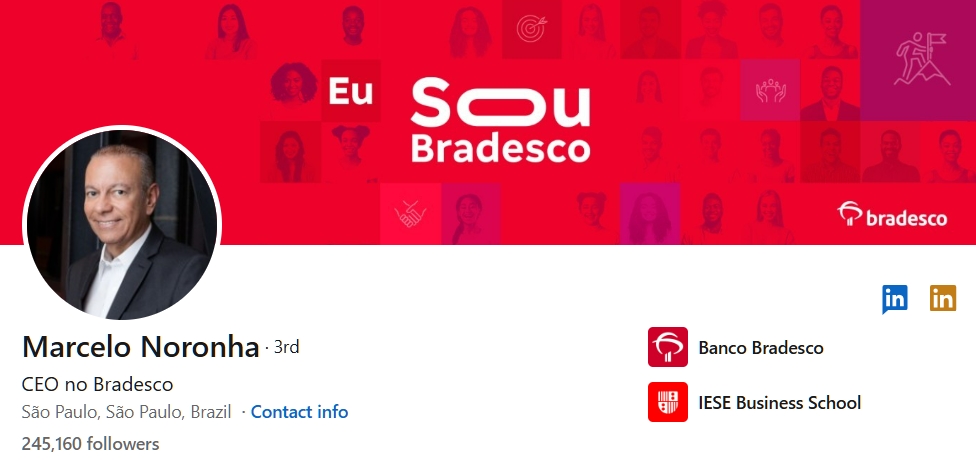
Marcelo Noronha is a veteran of the Brazilian financial sector who climbed the ranks through decades of dedication.
He holds a degree in Business Administration from the Federal University of Pernambuco and has spent over 38 years in the financial market.
His career is a testament to long-term institutional commitment, having dedicated 20 of those years specifically to the Bradesco Organization.
About Banco Bradesco
Bradesco is a financial giant with a massive footprint in Brazil. It manages a diverse portfolio including insurance, commercial banking, and investment services. The bank recently reported a focus on digital efficiency and credit quality.
LinkedIn Content Strategy Analysis
Who should follow Marcelo: Banking professionals, investors, employees and partners of Bradesco, financial services executives, and anyone following Brazil's large incumbent banks through a period of strategic reinvention.
Core Value Proposition: As CEO of Bradesco, Marcelo has built one of the most consistently engaged executive feeds in Brazilian finance. His strategy centers on radical proximity: he writes casually, shows up at branches and events, and makes financial results feel accessible rather than distant.
Key Themes & Topics
- Quarterly Results and Financial Performance - He turns earnings releases into LinkedIn content with a consistency and accessibility that stands out. Each report gets a personal post with context, tone, and a video summary:
- Q4, Q1, Q2, and Q3 earnings posts are recurring fixtures
- Results are narrated around the "step by step" transformation thesis he set out at the start of his tenure
- Bradesco's Strategic Transformation - His tenure narrative: consistent, optimistic execution of a multi-year restructuring plan. Posts repeatedly frame results as proof that the strategy is working.
- BradSaúde: the consolidation of Bradesco's health assets into a standalone listed entity (R$52B revenue at launch)
- Bradesco Asset Management reaching R$1 trillion AUM
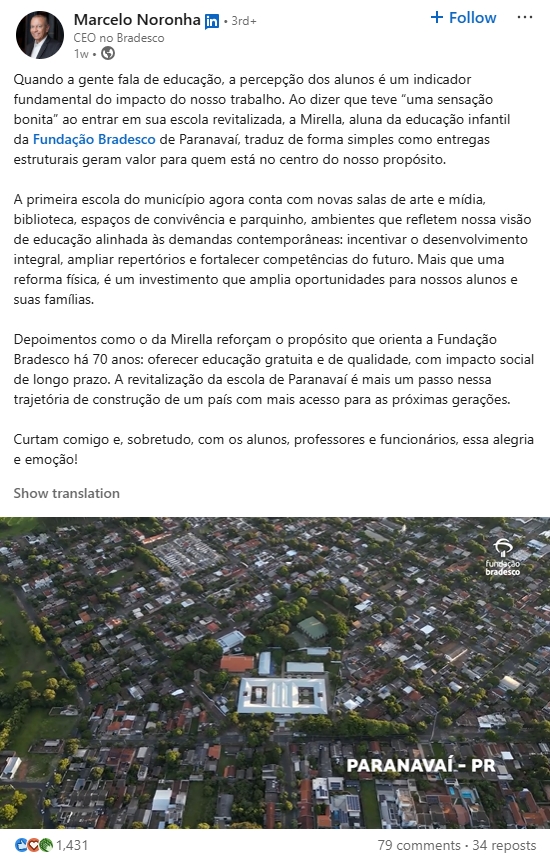
- Proximity to People - This is where his feed separates itself from other bank CEOs. He posts about "Resenha com CEO" informal employee meetings, visits to branches and the Agrishow, and conversations with frontline staff:
- "Quanto você muda ao longo de um ano?" posts reflecting on personal growth
- Recognizing employee milestones and events
- Reflection and Leadership Philosophy - Occasional more personal posts about what he has learned after 20 years at Bradesco.
Format and Presentation Style
He opens posts conversationally with "Fala, pessoal!" or "Olá, pessoal! Tudo bem?" and writes in a warm, direct Brazilian Portuguese that is notably informal for a CEO of a major bank. Posts use numbered summaries for results (clear, scannable), and videos are a major part of his strategy, regularly accompanying earnings announcements. Almost all content is in Portuguese.
Engagement Strategy
Marcelo's engagement numbers are consistently the highest of the five people analyzed here, with most posts generating thousands of reactions. He appears to have built a genuine community rather than just a follower count. His comment sections are active and substantive. He occasionally tags colleagues and posts about external events like Davos and Agrishow to contextualize his activity.
Performance Indicators
Reactions per post range from roughly 2,500 to 6,700, with an average around 3,300. That is exceptionally high for an executive without an influencer background. One of his best recent performing post was a reflective piece on 20 years at Bradesco and what he continues to learn as CEO, generating 6,000+ reactions, 600+ comments, and 263+ reposts.
Overall Strategy Summary
Marcelo has figured out something most bank CEOs have not: proximity beats prestige. By showing up in his own posts as a regular person who visits branches, hosts informal chats, and learns from employees, he makes a 100-year-old bank feel alive. His content strategy is essentially trust-building at scale, and the numbers prove it works.
Gilberto Tomazoni – Global CEO, JBS
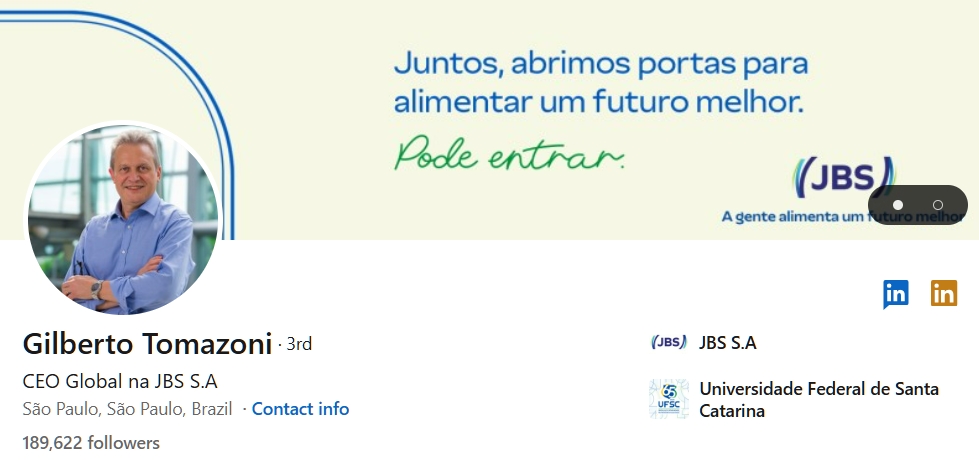
Gilberto Tomazoni leads a global empire from a perspective rooted in the food industry.
He is a mechanical engineer who started his journey as an intern at Sadia and stayed there for 27 years, eventually rising to the position of CEO.
This rare career path from trainee to top executive gives him an unmatched depth of knowledge in the supply chain.
About JBS
JBS is the largest protein producer in the world. It operates in multiple countries and handles brands that reach millions of tables every day. The company is currently working toward a Net Zero goal for 2040.
LinkedIn Content Strategy Analysis
Who should follow Gilberto: Agribusiness executives, sustainability leaders, supply chain professionals, investors in food production, and anyone tracking Brazil's role in global protein markets.
Core Value Proposition: As Global CEO of JBS S.A., Gilberto uses LinkedIn as an institutional platform, positioning himself as the public face of one of the world's largest food companies, with 2.3M+ followers. His content bridges corporate performance, global expansion, and ESG commitments into a consistent leadership narrative.
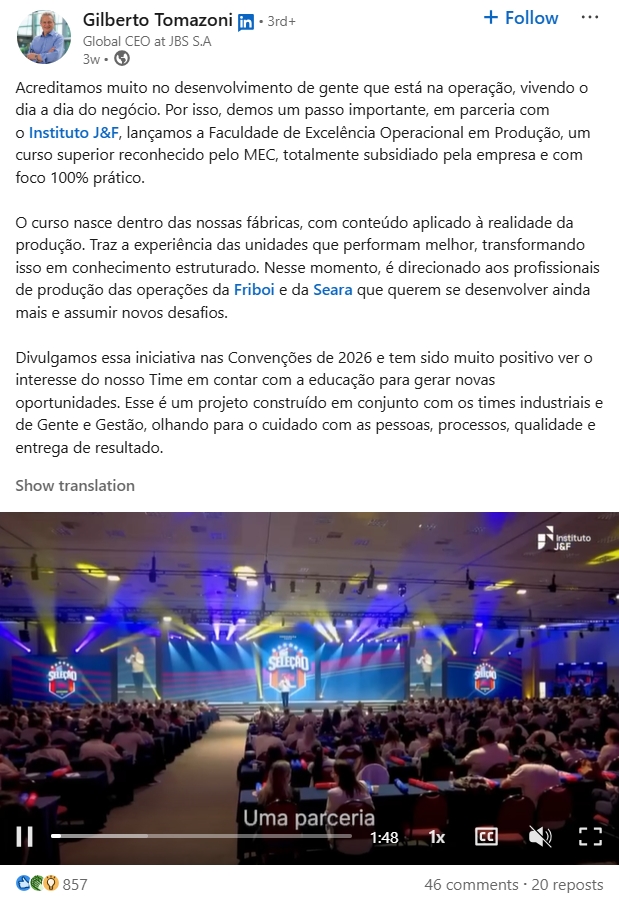
Key Themes & Topics
- Global Expansion and Partnerships - His highest-performing content. Announcements about international deals, joint ventures, and new production capacity (Saudi Arabia, Oman, Paraguay, the US) consistently generate strong engagement:
- Halal production hub expansion in the Middle East
- Acquisition of Hickman's Egg Ranch in the US
- Strategic investments in South American operations
- Sustainability and Animal Welfare - A recurring and clearly intentional pillar:
- Seara's transition to 100% collective gestation for swine
- Green Offices supporting small farmers with traceability tools
- Renewable energy initiatives and CO2 emissions reduction
- Brand and Product Performance - Celebrates market leadership milestones for JBS brands like Friboi and Seara, tying product wins to strategic execution.
- Leadership and Culture - Occasional posts on trust, people development, and employee recognition (long-tenure honorees). These are lighter in tone but clearly humanize the brand.
Format and Presentation Style
Posts follow a clean, institutional pattern: a declarative opening line, followed by 3-5 short paragraphs, often with a closing statement reinforcing values or strategy. He uses both Portuguese and English, suggesting deliberate audience segmentation. Images of operations, partnerships, and branded visuals accompany most posts. Videos are used sparingly but drive solid early engagement.
Engagement Strategy
Gilberto does not appear to use hashtags heavily or drive traffic to external content. The content is outward-facing but CEO-branded, meaning the posts read as authored by him but serve JBS's institutional positioning. Reposts are occasional and tend to amplify formal institutional recognitions.
Performance Indicators
Reactions range from 300 to 2,000+ per post, with averages around 530. His best recent performing post announced a joint venture and production expansion in Saudi Arabia, earning over 2,000 reactions and 23 reposts. Posts on sustainability programs and small farmer support also consistently outperform the feed average.
Overall Strategy Summary
Gilberto's LinkedIn is a well-managed CEO channel where business announcements and ESG milestones do the heavy lifting. He is not building a personal brand so much as reinforcing JBS's global credibility through his voice. The strategy works because the content is substantive, the company is genuinely newsworthy, and the combination of Portuguese and English reflects the reality of running a global Brazilian company.
Jeane Tsutsui – CEO, Fleury Group
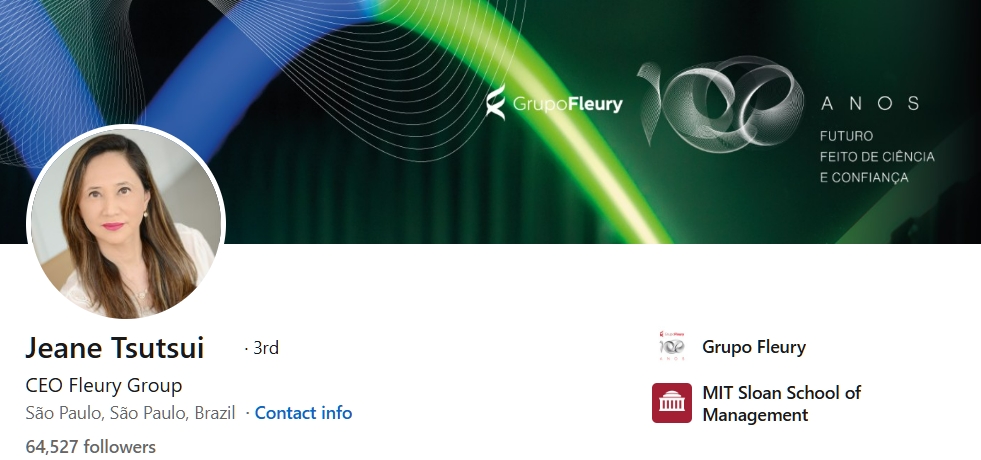
Jeane Tsutsui began her career in the consultation room as a cardiologist after graduating from the Ribeirão Preto Medical School.
She eventually traded her stethoscope for a corporate headset, bringing a doctor's precision and a professor's depth to the executive suite.
Her career reflects a mastery of adaptability, transitioning from clinical medicine to high-level corporate leadership over 14 years.
About Fleury Group
Fleury Group is a premier diagnostic and health organization in Brazil with over 95 years of history. It operates a vast network of laboratories and specialized clinics focusing on medical excellence.
LinkedIn Content Strategy Analysis
Who should follow Jeane: Healthcare executives, investors in Brazilian medical diagnostics, professionals tracking M&A in health services, and leaders navigating institutional transformation.
Core Value Proposition: As CEO of Grupo Fleury, Jeane uses LinkedIn to communicate a multi-front expansion strategy while anchoring it in a 100-year institutional legacy. Her content positions her as both a steward of history and a driver of modernization.
Key Themes & Topics
- M&A and Strategic Expansion - Her highest-performing content by a clear margin. Each acquisition announcement generates significantly more engagement than her other posts:
- Acquisition of Femme Laboratório da Mulher, a women's health reference in São Paulo
- Acquisition of a clinical analysis and vaccine operation in the Paulista interior
- These posts perform well because they combine institutional news with a clear strategic rationale
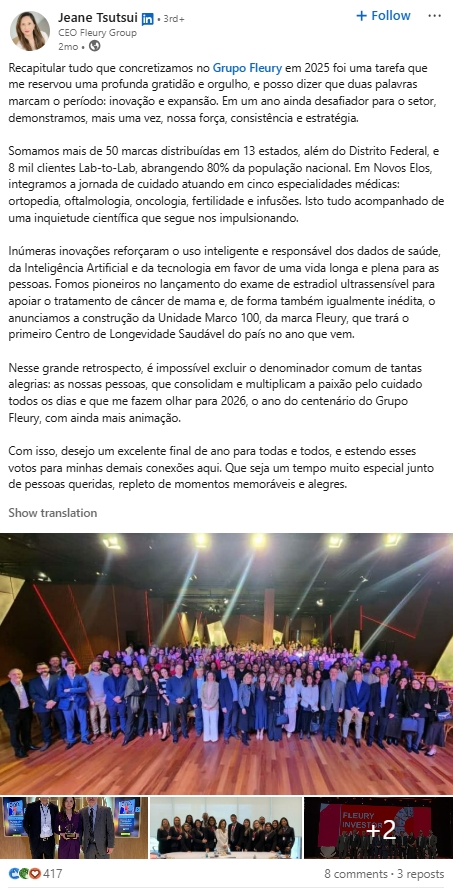
- Grupo Fleury's Centenary - A recurring motif across multiple posts, used as a lens for talking about heritage, values, and future direction. The 100-year milestone gives her content a narrative thread that is not available to younger companies.
- Recognition and Awards - Several posts cover rankings and accolades (influence rankings based on press analysis and social engagement, supply chain excellence awards). These are framed around values rather than vanity.
- Innovation and Healthcare Trends - Posts on aging and preventive health (Unidade Marco 100), telemedicine expansion in underserved communities, and the changing way Brazilians approach their own health. These are more reflective in tone.
- Leadership Events and Culture - Posts from executive retreats, leadership assemblies, and external conferences. These are frequent but generally lower in engagement than strategic announcements.
Format and Presentation Style
Posts are written in formal Brazilian Portuguese and tend to run longer than average. Jeane writes in full paragraphs with a clear institutional voice. She rarely uses lists or fragmented formatting. Photos from events and acquisitions accompany most posts, and the visual style is corporate but warm.
Engagement Strategy
Engagement is more selective than some peers: most posts generate 300 to 900 reactions, with acquisition announcements clearly breaking away from the baseline. She does not appear to use hashtags frequently or drive traffic externally. Content is self-contained and rarely invites direct audience participation.
Performance Indicators
Reactions range from roughly 330 to 2,100. Her best recent performing post announced the acquisition of Femme Laboratório da Mulher, generating 2,091 reactions, 83 comments, and 39 reposts. The second-best was a more personal reflection on what entrepreneurship and leadership share in common, which performed unusually well relative to her typical content, suggesting her audience responds when she steps outside strictly institutional framing.
Overall Strategy Summary
Jeane's LinkedIn is a reliable institutional channel that reflects the personality of the business itself: prestigious, purposeful, and historically grounded. The centenary narrative is a genuine strategic differentiator. Where she leaves engagement on the table is in personal voice: her feed is polished but rarely surprising, and the data suggests her audience would reward more moments of candor or reflection.
Joaquim Torres – Founder & CEO, Gyaco
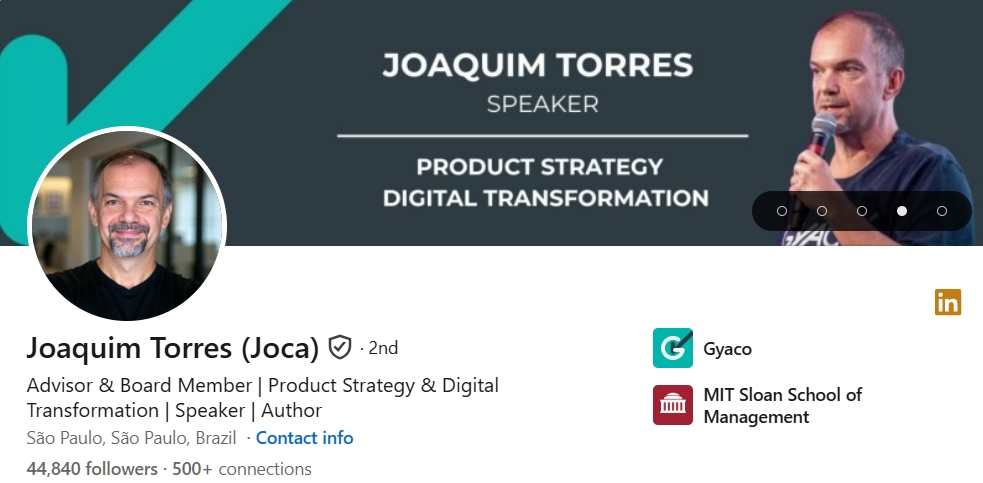
Joaquim Torres, known to many as Joca, is a pioneer in the Brazilian product management community.
He has spent years building digital products and teaching others how to do the same at companies like Locaweb and Gympass.
His move to found Gyaco is the latest chapter in a career dedicated to evangelical product excellence and mentorship.
About Gyaco
Gyaco is a consultancy and training firm focused on helping companies improve their digital product strategies. They provide advisory services to help businesses scale their product operations effectively.
LinkedIn Content Strategy Analysis
Who should follow Joca: Product managers, CPOs, founders building product organizations, tech leaders in Brazil and internationally, and anyone navigating the intersection of product culture and company transformation.
Core Value Proposition: Joca positions himself as a practitioner-turned-advisor on product management and digital transformation, combining 30+ years of hands-on experience (including founding one of Brazil's first internet providers in the 1990s) with a consulting and writing practice aimed at helping companies build genuine product culture.
Key Themes & Topics
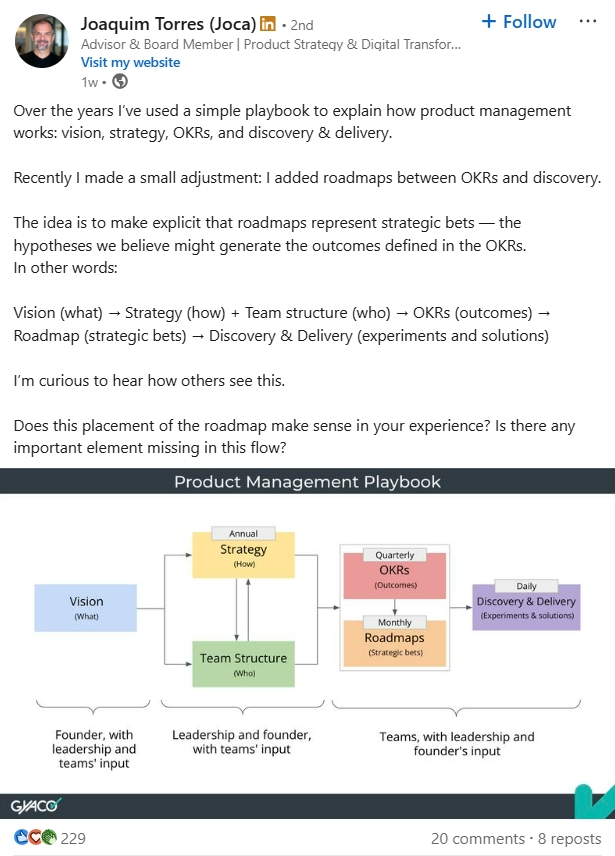
- Product Culture and Operating Models - His most intellectually consistent theme. He argues that "product culture" and "product operating model" are not separate concepts but the same transformation described in different words, and keeps returning to this idea across posts and articles.
- Strategic context as the foundation before talking about team autonomy or structure
- Why product discovery faces resistance from business stakeholders
- Frameworks and Mental Models for Product Leaders - Practical, applicable content for people doing the work:
- CTO + CPO vs. CPTO leadership structures
- Team reorganization as a strategic and costly decision
- Vision, strategy, and execution as a connected chain
- AI and Its Impact on Product Work - A growing thread, often with a contrarian angle:
- Resistance to AI appearing more from the tech side than from business
- Speed without product maturity accelerating mistakes
- Returning to coding himself as an experiment, shared with humor and nostalgia
- Personal Stories and Career Reflection - Some of his best-performing posts come from personal history:
- His 2007 email to Marty Cagan before Inspired was published
- His early career as a programmer at Dialdata in the 1990s
- A recovery post following an accident, written in a notably vulnerable register
Format and Presentation Style
Joca writes in both Portuguese and English, often labeling posts "[PT]" for Portuguese-only content. His best posts use a staccato, punchy paragraph structure with short declarative sentences that build tension before a reveal. He consistently links back to his website (gyaco.com) and promotes longer-form articles, making LinkedIn a top-of-funnel for deeper content. Occasional carousels summarize written pieces.
Engagement Strategy
His engagement is more volatile than the corporate executives in this group, ranging from under 100 to over 2,000 reactions. He actively promotes himself as a speaker, author, and advisor, and uses posts to signal availability for consulting engagements. He shares job openings for advisee companies, reinforcing his network role. Hashtag usage is light.
Performance Indicators
Most posts generate 40 to 500 reactions. His best recent performing post was the "returning to coding" story, mixing nostalgia with personal history about founding one of Brazil's first internet providers in the 1990s, generating 726 reactions and 110 comments. His Marty Cagan story and a post synthesizing product culture thinking both landed around 486 reactions, confirming that narrative and personal history are his strongest content formats.
Overall Strategy Summary
Joca has a clearly defined niche, a genuine point of view, and a long enough track record to back it up. His content works best when he anchors ideas in personal experience, and where it loses steam is in more generic framework posts that lack that grounding. For someone building a consulting and thought leadership practice, his LinkedIn is doing the right job. The ceiling is still well above where most of his posts land, and the gap suggests more personal storytelling mixed into the intellectual content could meaningfully lift his average engagement.
Ana Cabral – CEO, Sigma Lithium
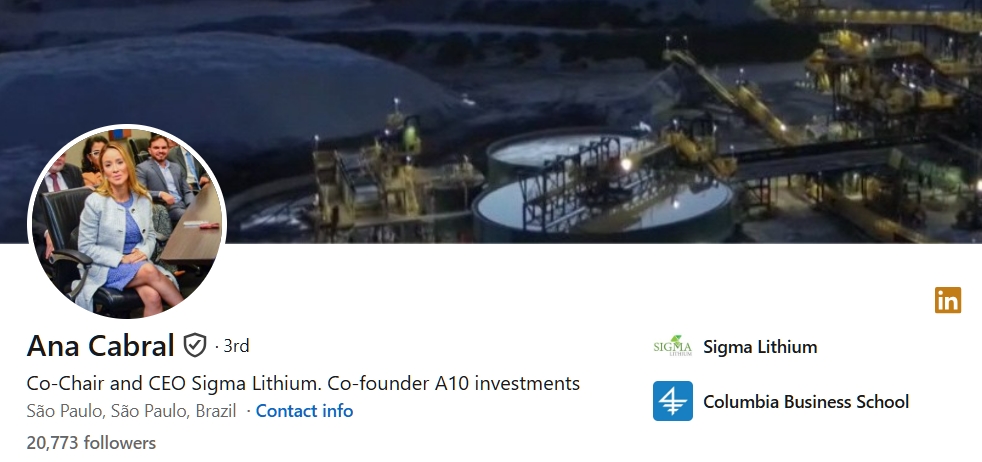
Ana Cabral is at the forefront of the global energy transition, having spent over 25 years as a senior banker in New York, London, and São Paulo.
She was one of the key leaders in the historic privatization of Vale in 1996, a project that shaped her understanding of natural resources.
Her work today at Sigma Lithium is a testament to the fact that industrial mining and environmental protection can coexist.
About Sigma Lithium
Sigma Lithium is a Canadian-Brazilian company producing high-purity lithium in Minas Gerais, Brazil. The company prides itself on its zero-carbon footprint and water-recycling technologies. It has been involved in transactions totaling approximately $150 billion.
LinkedIn Content Strategy Analysis
Who should follow Ana: Mining and critical minerals executives, clean energy investors, ESG-focused institutional investors, policymakers tracking Brazil's role in the energy transition, and anyone following lithium markets globally.
Core Value Proposition: As Co-Chair and CEO of Sigma Lithium, Ana uses LinkedIn as a platform for three things simultaneously: narrating Sigma's operational story, positioning Brazil as a critical minerals leader, and making the case for lithium's role in the global energy transition. The voice is personal, occasionally unpolished, and all the more credible for it.
Key Themes & Topics
- Energy Transition and Critical Minerals - Her most consistent intellectual thread. Ana writes with conviction about lithium's strategic role in decarbonization, the dynamics of battery supply chains, and the importance of responsible, traceable sourcing:
- Lithium market cyclicality and what matters beyond spot price (margins, not revenue)
- Brazil's comparative advantage in the energy transition
- The geopolitics of critical minerals in US, Chinese, and European industrial policy
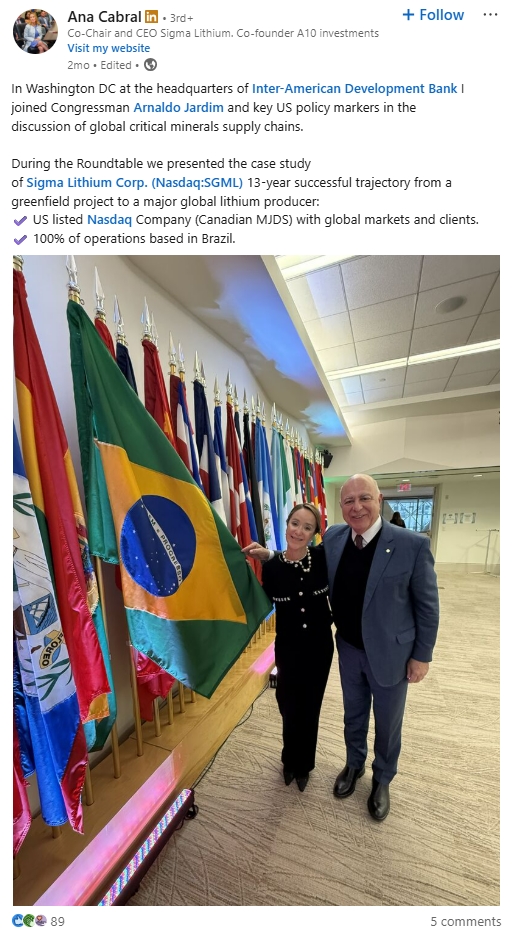
- Sigma Lithium Operations - Operational updates serve as a running proof of concept for her broader thesis. Posts on mine restarts, team mobilization in Vale do Jequitinhonha, and the first lithium-backed prepayment deal are framed around community impact as much as financial performance.
- Reposts and Amplification - A large share of Ana's feed is reposts rather than original content. She amplifies António Guterres on fossil fuel disinformation, UN Climate Change on gender and COP30, World Economic Forum on minerals and AI demand, and McKinsey on green materials. These reposts generate some of her highest engagement because the original content carries large audiences with it.
- Women in Business and Personal Relationships - Occasional but warm posts: a tribute to her late mentor Raul Jungman, a post on the unbreakable bond among working women, and a photo with longtime friends. These humanize a feed that is otherwise heavily industry-focused.
- Global Conference Presence - Posts from Davos, Saudi Arabia, Shanghai, and Rome signal her positioning as a global executive, not just a Brazilian mining CEO.
Format and Presentation Style
Ana writes in English for most posts, with occasional Portuguese for domestic audiences. Her writing style is informal, uses ellipses and emoji frequently, and reads like dispatches rather than polished corporate communications. Posts are short, often leading with a bold statement or an emotional hook. She does not use structured lists. The Sigma Lithium company page is frequently tagged, creating a two-channel presence.
Engagement Strategy
Her most-engaged posts are reposts from major institutions (UN, WEF, Guterres), which benefit from those accounts' reach. Her original posts perform more modestly, with most generating between 50 and 200 reactions. She does not appear to use hashtags heavily in her own posts but benefits from hashtags in the content she reposts. External links and media appearances (Bloomberg, Mining.com interviews) are shared regularly.
Performance Indicators
Original posts typically generate 50 to 500 reactions. One of her best recent performing original posts was a tribute to Pope Leone XIV following a personal encounter during the Jubilee in Rome, generating 1,243 reactions. A post on Sigma resuming mining operations with a message about the Vale do Jequitinhonha community also performed solidly. Her highest-engagement content overall came from reposts of Guterres's COP30 statements, which reached 3,950 and 3,364 reactions respectively, though that reflects those accounts' reach rather than her own.
Overall Strategy Summary
Ana's LinkedIn presence is that of a global executive who has strong views, a compelling operational story, and a genuine belief in what her company is building. The repost-heavy strategy helps her stay present and relevant on big global themes without the overhead of constant original writing. The growth opportunity is in more original, long-form content that connects her personal experience in mining to the macro narratives she amplifies. When she writes from her own voice, the authenticity comes through clearly.
Frederico Trajano – CEO, Magazine Luiza
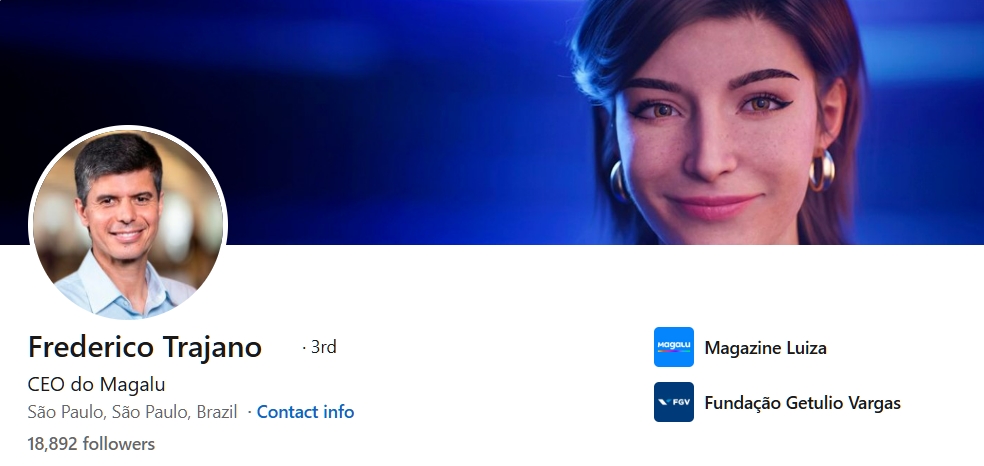
Frederico Trajano took a family retail business and turned it into a digital powerhouse after starting his career in finance in 2000.
He famously empowered an innovation team called Luiza Labs to work outside traditional bureaucracy, a move that became a Harvard Business School case study.
His visionary approach earned him the "Man of the Year" title from GQ Magazine and the "Entrepreneur of the Year" award from Valor Econômico.
About Magazine Luiza
Magazine Luiza, or Magalu, is one of the largest retail companies in Brazil with over 1,500 physical locations and 30,000 employees. Today, more than 70% of Magalu's revenue comes from e-commerce.
LinkedIn Content Strategy Analysis
Who should follow Frederico: Retail and e-commerce executives, Brazilian tech and business leaders, investors tracking digital transformation in consumer markets, and anyone building at the intersection of physical retail and AI.
Core Value Proposition: As CEO of Magazine Luiza, Frederico has built one of the most energetic executive feeds in Brazilian business. He uses LinkedIn to narrate Magalu's transformation story in real time, blending institutional announcements with personal milestones in a way that makes the company feel alive and its leadership feel human. He has 2.6M+ followers.
Key Themes & Topics
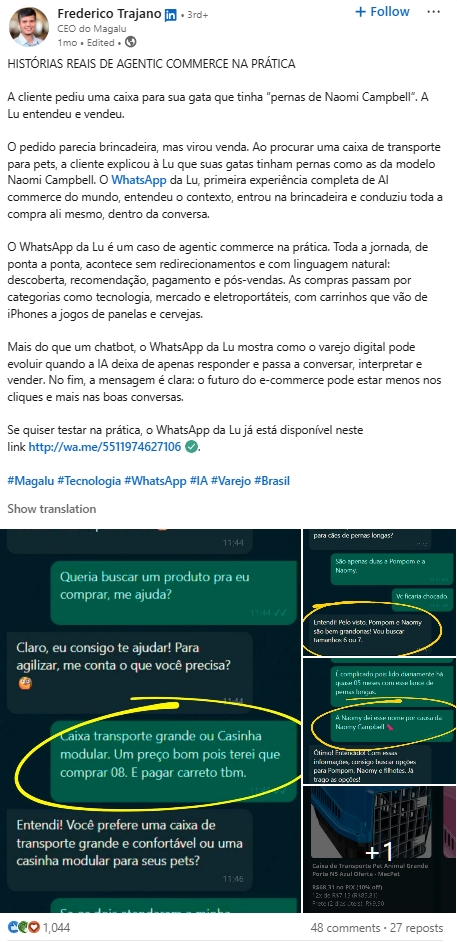
- AI Commerce and the Lu Strategy - His most forward-looking content thread. Frederico frames Magalu's AI investments not as experiments but as the company's next defining chapter:
- The launch of Lu as a fully autonomous, multimodal AI commerce assistant
- The "12 Apostles of Brazilian AI," Magalu's first AI-focused trainee cohort
- Posts on agentic commerce in practice, with real customer interaction examples
- Galeria Magalu and the Avenida Paulista Project - A recurring anchor. The opening of the new flagship store and cultural space on Avenida Paulista generated his highest-engagement posts, framed around three strategic pillars: multichannel materialization, urban revitalization, and cultural connection.
- Magalu's Track Record and Resilience - Posts contextualizing Brazil's economic turbulence (six currencies, hyperinflation, eight failed economic plans) as the backdrop against which Magalu was built. These posts position the company as an institution, not just a business.
- Personal Endurance and Discipline - A surprisingly strong content vein. His New York Marathon post, documenting 1,500 km of training and 20kg lost, generated 3,109 reactions. His cycling posts perform similarly well. The personal content signals character without being unrelated to his professional brand.
- Social Purpose - Occasional but high-quality posts on employment as social policy, Dia de Doar philanthropy, and the role of business in reducing poverty.
Format and Presentation Style
Frederico writes almost entirely in Portuguese, with punchy openings and a narrative structure that builds toward a reveal or a thesis. Posts are medium length, rarely using numbered lists, instead relying on short paragraphs with clear momentum. Images and videos accompany most announcements. His writing voice is personal and confident without being self-congratulatory.
Engagement Strategy
He does not use hashtags heavily and rarely drives traffic externally. The content is self-contained. He appears to have opened his LinkedIn presence relatively recently and grew quickly, noting in one post that 1 million followers in under three months was never a goal. He occasionally mentions panels and events (NRF, Netflix leaders visit) to broaden the context around Magalu's positioning.
Performance Indicators
Reactions range from roughly 700 to 4,200 per post, with an average around 1,150. One of his best recent performing posts was the Galeria Magalu inauguration on Avenida Paulista, generating 4,254 reactions, 206 comments, and 96 reposts. The New York Marathon post was not far behind at 3,109 reactions, showing that personal content competes directly with major institutional announcements.
Overall Strategy Summary
Frederico's LinkedIn works because he does not separate the company story from his own. The AI bets, the marathon training, the cultural project on Paulista, the resilience narrative: they all feel like expressions of the same person. That coherence is hard to manufacture and drives consistently strong numbers across very different types of content.
Marcus Fontoura – CTO Azure Core, Microsoft
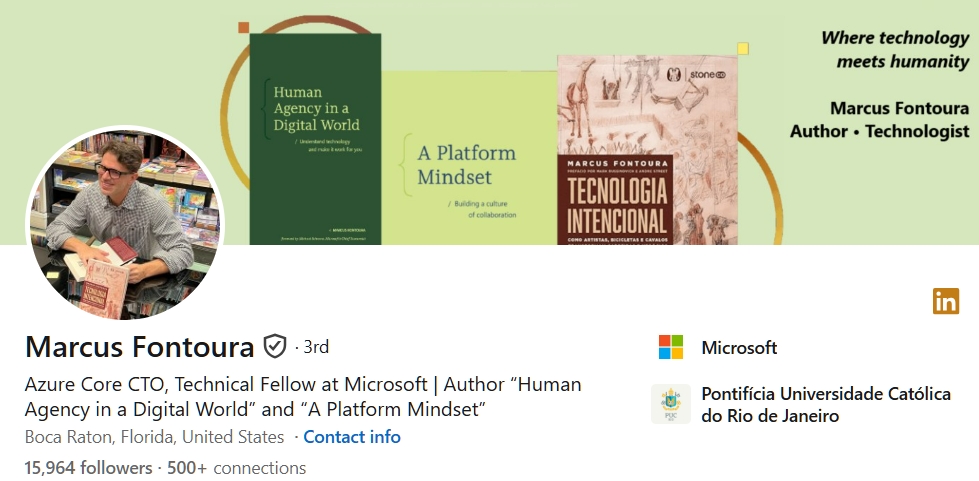
Marcus Fontoura is one of the most prominent Brazilians in the global tech scene, having earned his Ph.D. at PUC-Rio.
Before leading core components of Azure at Microsoft, he held research positions at tech giants Google, Yahoo, and IBM.
His career is marked by intellectual rigor, with over 50 patents and an ACM Distinguished Member recognition.
About Microsoft Azure
Azure is a leading global cloud computing service created by Microsoft. It provides services for computing, analytics, storage, and networking. It powers a significant portion of the world's digital infrastructure.
LinkedIn Content Strategy Analysis
Who should follow Marcus: Tech leaders and senior engineers, people working at the intersection of AI and society, Brazilian professionals in the global tech industry, and readers interested in the human dimensions of digital transformation.
Core Value Proposition: Marcus is a senior technologist at Microsoft with deep experience across Microsoft, Google, and Yahoo, and he uses LinkedIn as an extension of his work as an author and public intellectual. His content is less about his employer and more about the ideas in his books, particularly his argument that intentional, human-centered technology is both possible and necessary.
Key Themes & Topics
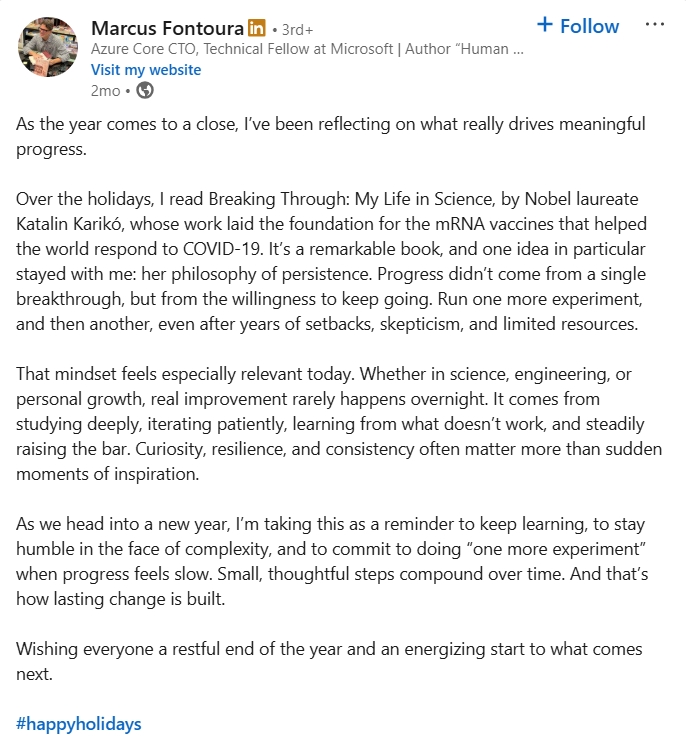
- Human Agency and AI - The dominant thread, tied directly to his book Human Agency in a Digital World. Posts explore how people can remain in control as AI automates more decisions, and why that question matters now:
- Why you should still study technology even if AI replaces entry-level jobs
- The tension between AI's efficiency gains and the "unnecessary steps where life happens"
- Intentional technology as a framework for companies and individuals
- Book Promotion and Authorship - A significant share of his recent posts are tied to his publication cycle: pre-orders, the physical copy arrival, reader reactions, book events in Seattle and Redmond, and podcast appearances. This is an explicit and honest use of LinkedIn as a book marketing channel.
- Talks and Community - Posts from BRASA Summit, Microsoft events, and panels on AI and society, mostly in English but occasionally in Portuguese for Brazilian audiences. He uses these to build credibility as a speaker and thought leader beyond the company.
- Computing and Society - Longer-form reflections shared as LinkedIn articles, including a piece on how the US two-party system polarizes through a computer science lens. This signals intellectual range beyond the AI-and-productivity lane.
Format and Presentation Style
Marcus writes in both English and Portuguese, sometimes labeling the language switch explicitly. Posts are conversational and relatively short, rarely using lists or structured frameworks. He relies heavily on external links (his website, book pages, article URLs) and consistently tags his website in his profile. The tone is warm and reflective rather than authoritative.
Engagement Strategy
Engagement is modest relative to his background, with most posts generating 50 to 175 reactions. He uses hashtags regularly (#futureofwork, #organizationalculture, #aplatformmindset) and links to his books and articles in virtually every post. The LinkedIn-as-book-funnel strategy is clear and consistent, even if the follower base is still growing into it.
Performance Indicators
Most posts generate between 40 and 175 reactions. One of his best recent performing posts was the announcement that he had received the first physical copy of Human Agency in a Digital World, generating 265 reactions and 32 comments. His AI career advice post ("Study Tech, even if AI replaces entry tech jobs") also performed well with 172 reactions. The numbers are modest but the audience is targeted and the content is consistent.
Overall Strategy Summary
Marcus is building a thought leadership presence that complements an already substantial corporate career. LinkedIn is clearly a secondary platform for him, used to extend the reach of his books and ideas rather than to build a primary audience from scratch. The content is thoughtful and the positioning is clear. The growth opportunity is in more personal storytelling and fewer pure book-promotion posts, which tend to underperform even with genuine substance behind them.
Ana Gabriela Oliveira Lopes – CMO, iFood
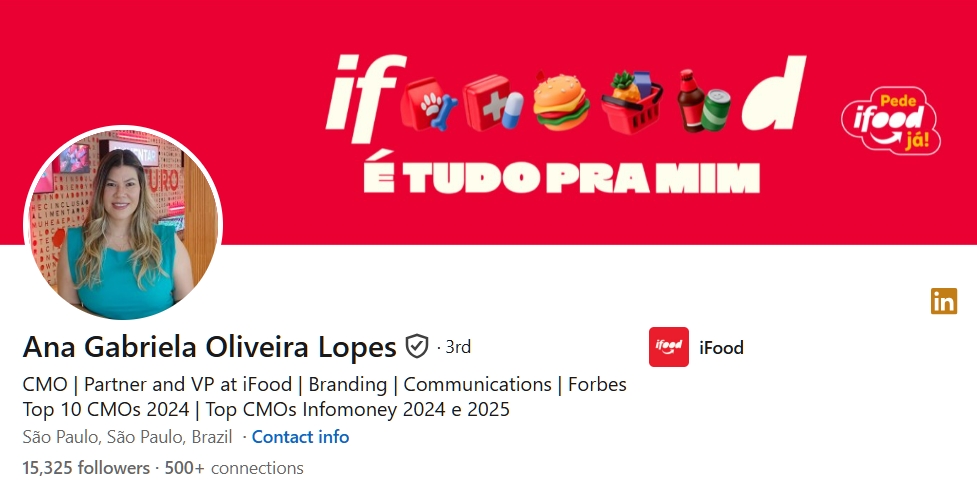
Ana Gabriela Oliveira Lopes is the creative force behind iFood, having been part of the journey since the brand's early DiskCook days.
She has navigated the competitive world of delivery apps by focusing on brand love and an "ownership mindset."
Her leadership has helped transform a startup into a brand that is synonymous with its category in Brazil.
About iFood
iFood is the leading food delivery platform in Latin America. It has grown exponentially, reaching 1 million orders per month as early as 2013 and eventually becoming the "most loved brand" in Brazil three times in a row.
Who should follow Ana Gabriela: Marketing professionals, brand strategists, e-commerce and retail leaders, and Brazilian tech and consumer industry executives interested in how a beloved local brand thinks about culture, growth, and identity.
Core Value Proposition: As Chief Marketing Officer of iFood, Ana Gabriela uses LinkedIn to tell the brand story from the inside. Her content is less about personal positioning and more about what it means to build a marketing function inside one of Brazil's most culturally resonant companies. She has 1.9M+ followers, driven in large part by iFood's institutional reach.
Key Themes & Topics
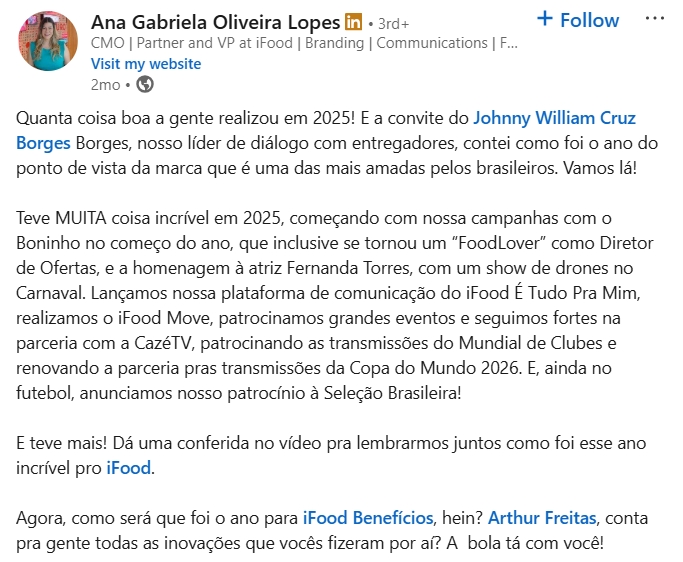
- Brand Love and Brazilian Identity - Her most consistent and emotionally charged thread. She frames iFood not as a delivery app but as part of the cultural fabric of Brazil:
- "Tem coisas que só quem é do Brasil entende" as a recurring motif
- The Canarinho mascot partnership, the Carnival drone shows, Henrique Fogaça becoming a brand ambassador
- Posts on what it means to build a brand Brazilians actually embrace
- Technology as a Brand Story - AI is not just a product feature in her telling; it is evidence of iFood's ambition:
- The LCM (Large Commerce Model) and AILO assistant as expressions of "technology with a Brazilian accent"
- AI commerce framed as culture-driven innovation, not just optimization
- Campaign and Partnership Milestones - A regular source of content: the BBB sponsorship concept ("iFood BBB: Brasileiro, Bom e Barato"), the Boninho partnership, CazéTV and the World Cup, the R$17 billion investment announcement at iFood Move.
- Awards and Team Recognition - Wins are consistently redirected to the team. Posts on marketing recognition rankings and brand awards become celebrations of the "Imparáveis" (as she calls her marketing team) rather than personal milestones.
- Cultural Curiosity and Social Awareness - Occasional posts that go slightly off-script in a good way: a visit to Rocinha with content creator Ruan Juliet, the viral Morango do Amor moment turned into a marketing observation, the Fogaça "fofoca" handled with timing and humor.
Format and Presentation Style
Ana Gabriela writes entirely in Portuguese in a warm, energetic register. Posts open with punchy one-liners or cultural hooks and build toward a statement of purpose. She uses emoji sparingly but effectively. Carousels are used for milestone recaps. The writing is accessible and enthusiastic without being shallow.
Engagement Strategy
Her highest-engagement posts tend to be iFood institutional content where the company's scale and cultural footprint do the work. She does not appear to drive traffic externally or use hashtags heavily. Team and ecosystem recognition are woven into most posts, reinforcing an inclusive narrative around the brand.
Performance Indicators
Reactions range from roughly 50 to 2,000 per post. One of her best recent performing posts was a year-in-review carousel celebrating 180 million monthly orders also performed strongly with 1,732 reactions and 1,280 reposts. Posts anchored in Brazilian cultural identity consistently outperform more operational announcements.
Overall Strategy Summary
Ana Gabriela's LinkedIn works because she is not just a CMO posting about marketing. She is a brand believer posting about Brazil. The iFood story and the Brazil story are inseparable in her feed, and that emotional grounding gives every campaign update and award announcement a sense of purpose beyond the metric. The content is most powerful when it is most culturally specific, and that is a deliberate choice.
Michelle Oliveira – Co-Founder And COO, Digital Manager Guru
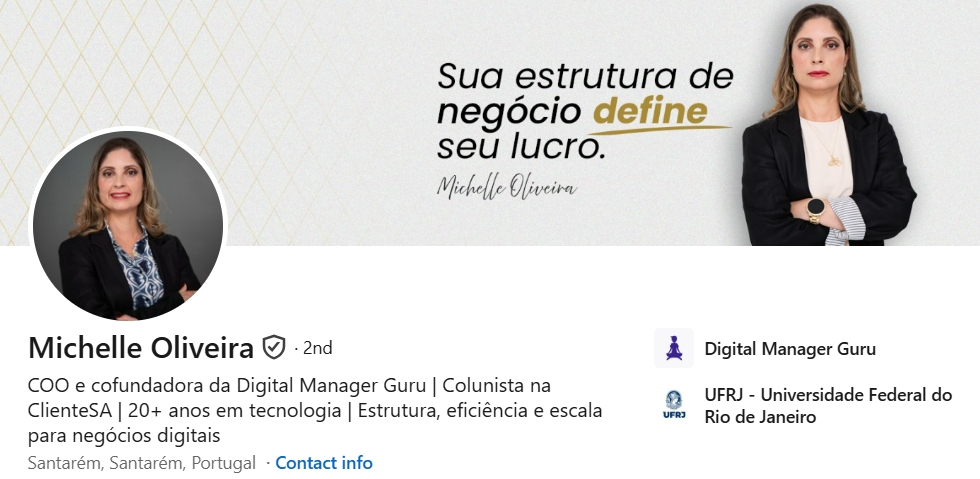
Michelle Oliveira is a leader in the Brazilian SaaS space who co-founded Digital Manager Guru after a sabbatical period in Portugal.
She has been involved in software projects since 2004, working with companies like Siemens and Valid on complex biometric and ID systems.
Her specialty lies in the rare ability to translate customer needs into technical developer language.
About Digital Manager Guru
Digital Manager Guru is a management platform for digital businesses that raised a $300,000 seed round in 2019. It offers tools for checkout, sales tracking, and integration with various marketing services to help small businesses scale.
Who should follow Michelle: Founders and leaders of small and medium digital businesses, e-commerce operators, COOs and operators building structure inside fast-growing companies, and anyone navigating AI adoption in non-enterprise contexts.
Core Value Proposition: As co-founder and COO of Digital Manager Guru, Michelle writes about the operational and cultural realities of building and scaling digital businesses, from a practitioner's perspective. She is not advising from a distance. She has been inside the machine, and her content reads that way.
Key Themes & Topics
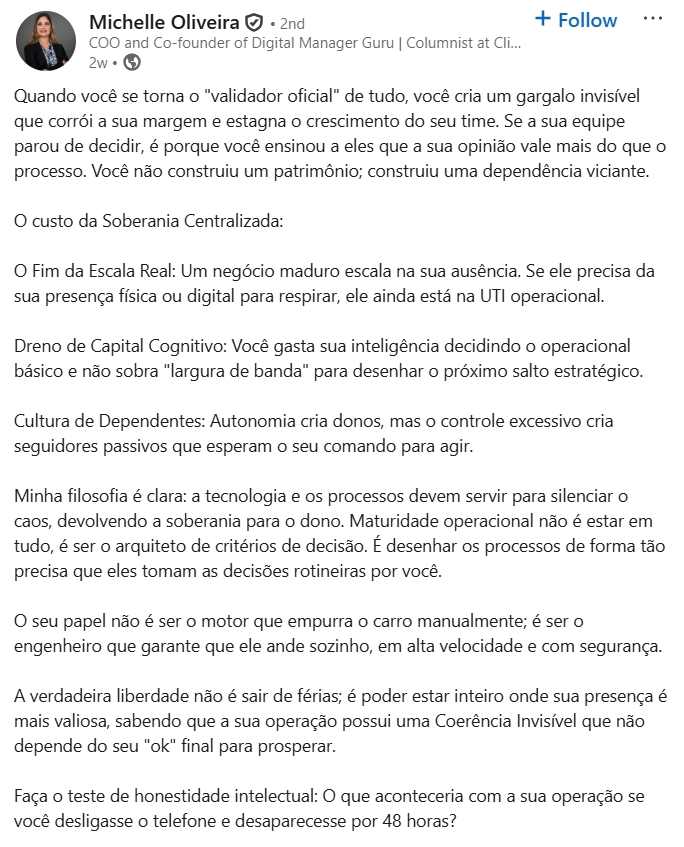
- Organizational Culture as a Structural Problem - Her strongest content thread and the source of her highest-engagement posts. She argues that culture failures are really process failures, and that most companies perform culture rather than build it:
- "Culture is not a motivational poster. Culture is what your leadership tolerates and what your operation allows"
- Posts on coherence between what leaders say and what the organization permits
- Scaling as a structural challenge, not a willpower challenge
- AI Adoption in Real Business Contexts - A growing and differentiated thread. Rather than promoting AI uncritically, she writes about the gap between conference narratives and the reality facing SMEs:
- AI amplifying bad processes rather than fixing them (a real case of an AI agent offering unauthorized discounts)
- The NRF 2026 agent commerce hype vs. the actual decision-making patterns of SME customers
- "Efficient Toxicity" in subscription businesses that automate away the human moments that retain customers
- Leadership as Responsibility for People - Personal and reflective posts on what leading actually involves:
- "You don't manage numbers. You manage lives."
- The distinction between movement and result, drawing on Andy Grove's High Output Management
- Hiring people smarter than you as a sign of strength, not insecurity
- Scaling Structure and Digital Operations - Practical content for operators:
- What happens when volume grows faster than structure
- The risks of digital omnipresence and the case for a "digital detox" inside the business
- Checkout experience as a retention lever in digital commerce
Format and Presentation Style
Michelle writes entirely in Portuguese with a direct, sometimes confrontational tone. She opens posts with bold declarative statements or provocative questions. Posts are medium-length with clear logical progression, often using bullet points to break down operational realities. Emoji is used as punctuation rather than decoration. The writing is clear-eyed and avoids motivational vagueness.
Engagement Strategy
Engagement is heavily concentrated in a small number of posts, with most generating under 100 reactions. She does not appear to rely on hashtags or external traffic drivers heavily. Posts from events (RD Summit, NRF) serve as credibility signals. She occasionally shares personal milestones such as being featured on the Nasdaq screen at Times Square and being recognized among Brazilian women transforming the innovation ecosystem, though these are not the posts that drive the most engagement.
Performance Indicators
Most posts generate between 5 and 120 reactions. One of her best recent performing posts was a sharp piece on organizational culture arguing that what most companies call culture is theater, generating 2,241 reactions and 145 reposts, a significant outlier from her average. A post on leading people rather than numbers reached 574 reactions. Both suggest her audience responds most strongly when she is direct, personal, and willing to name something uncomfortable.
Overall Strategy Summary
Michelle is building a voice that is clearly her own: operational, honest, and grounded in real experience running a digital business. The gap between her average post and her best posts is large, which means there is real upside if she can bring the clarity and conviction of her top content into her regular cadence. The culture and leadership posts are where she is most herself, and those are also the posts that travel furthest.

.jpg)