

7 Danish Female Executives Crushing It on LinkedIn in 2026
Written by

If you're already active on LinkedIn but want your posts to reach more people, start better conversations, and strengthen your professional reputation, studying successful executives is one of the fastest ways to improve.
For this roundup, we used Claude to analyze each executive's LinkedIn presence in depth. Instead of focusing on follower counts, it examined their content strategy, recurring themes, posting style, audience engagement, and the value they consistently deliver.
The result is a practical breakdown of what makes their LinkedIn presence so effective.
Whether you're an executive, founder, or aspiring leader, these Danish women show different ways to build authority, share expertise, and build a professional brand that earns attention for the right reasons.
And if you're ready to put these insights into practice, start your free 14-day trial of Will and get AI-powered feedback to improve your own LinkedIn content.
Mette Lykke – CEO, Too Good To Go
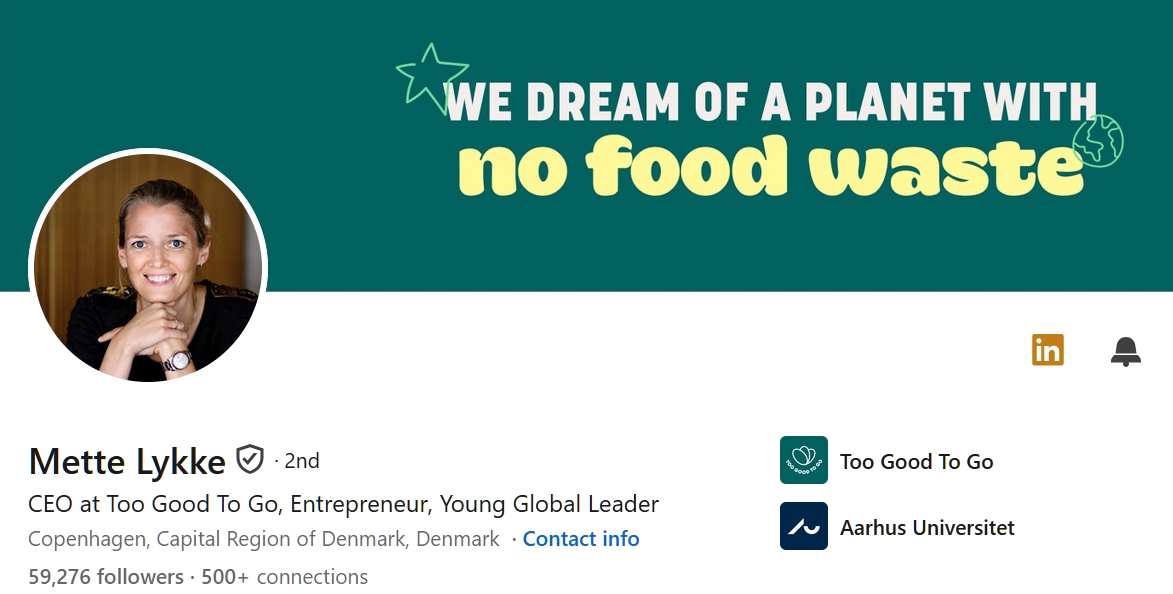
Mette Lykke grew up in Ringkøbing, Denmark, and began her corporate journey in management consulting at McKinsey & Company.
In 2007, she co-founded the fitness community and tracking app Endomondo, which scaled to millions of active users worldwide before being acquired by Under Armour in 2015.
After leading Endomondo through its global expansion, Mette transitioned to a new challenge in 2017 when she joined Too Good To Go as Chief Executive Officer.
Seeing the immense potential of a marketplace designed to combat food waste, she transformed the Copenhagen startup into an international environmental brand operating across multiple continents.
About Too Good To Go
Too Good To Go is a certified B Corp social impact company that operates a digital marketplace connecting consumers with local stores and restaurants to purchase unsold surplus food. Across 21 countries in Europe, North America, and Asia-Pacific, the company has grown to over 120 million registered users and 180,000 active business partners, saving more than 500 million meals from being wasted.
LinkedIn Content Strategy Overview
Who should follow Mette: Founders, sustainability leaders, impact investors, and anyone interested in scaling a purpose-driven tech company globally
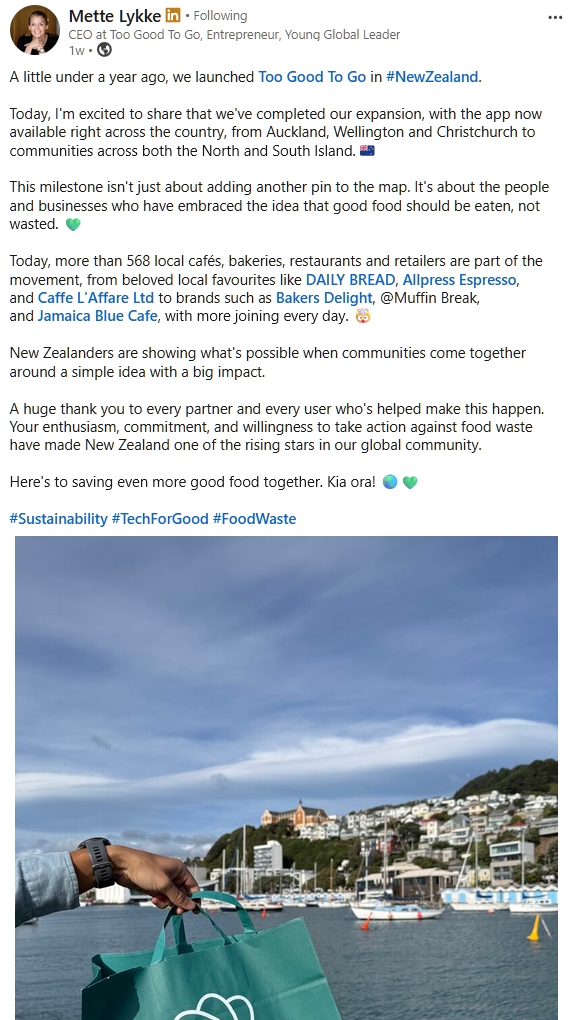
Core Value Proposition: As CEO of Too Good To Go with 59,275 followers, Mette positions herself as the face of a global movement against food waste, combining hard growth metrics with warm, human storytelling to show that purpose and business performance can scale together.
Key Themes & Topics
- Global Expansion Milestones - Her most frequent and highest-performing content:
- New market launches (New Zealand, Japan, and others)
- App Store rankings and press coverage in new countries
- Country-specific team recognition and local partner shoutouts
- User Stories and Community Impact - Human-centered storytelling that humanizes the platform:
- Spotlighting individual "super users" and their personal journeys with the app
- Highlighting how much money or food users have saved
- Video testimonials showing real people using the product
- Company Metrics and Impact Reporting - Data-driven proof points reinforcing scale:
- User milestones like reaching 150 million registered users
- Annual Impact Reports quantifying meals saved and partners onboarded
- Framing sustainability and profitability as a "win-win-win"
- Hiring and Culture - Recruitment content tied to mission:
- Job openings framed as opportunities to fight climate change through commercial work
- Descriptions of company culture and values
Format & Presentation Style
- Video-forward content - many posts include embedded video clips, from user testimonials to press appearances
- Emoji-rich, upbeat tone throughout, using icons to mark sections and add energy
- Milestone-driven headlines that lead with a striking number or achievement
- Consistent hashtag set - regularly reuses #TechForGood, #FoodWaste, #Sustainability, and #Impact
- Gratitude and team credit - frequently names local teams and individual employees behind each milestone
- Media embeds and links - often links out to press coverage, TV clips, or impact reports
Engagement Strategy
- Global storytelling rotation - cycles through different countries and markets to keep content fresh and geographically relevant
- Third-party validation - leans on press mentions, app store rankings, and media appearances as social proof
- Community spotlighting - inviting followers to tag or suggest other super users keeps the audience participating
- Purpose-first framing - nearly every post ties back to the climate and food waste mission, reinforcing brand consistency
Performance Indicators
Mette's posts perform consistently well, with most landing between 130 and 500 reactions and frequent reposts in the double digits, reflecting a highly shareable, brand-aligned content style. One of her best recent performing posts, announcing that Too Good To Go became the number one app on the Japanese App Store shortly after launch, stood out sharply with nearly 2,400 reactions, 89 comments, and 39 reposts, showing that major expansion news paired with local recognition is her strongest content format.
Overall Strategy Summary
Mette runs one of the most polished and consistent executive content strategies in this group, functioning almost as an extension of Too Good To Go's brand marketing. Her mix of hard growth numbers and warm human stories keeps the account feeling authentic rather than corporate, and her strongest posts prove that global milestones paired with local, human credit are what truly break through.
Natasha Friis Saxberg – CEO, IT-Branchen
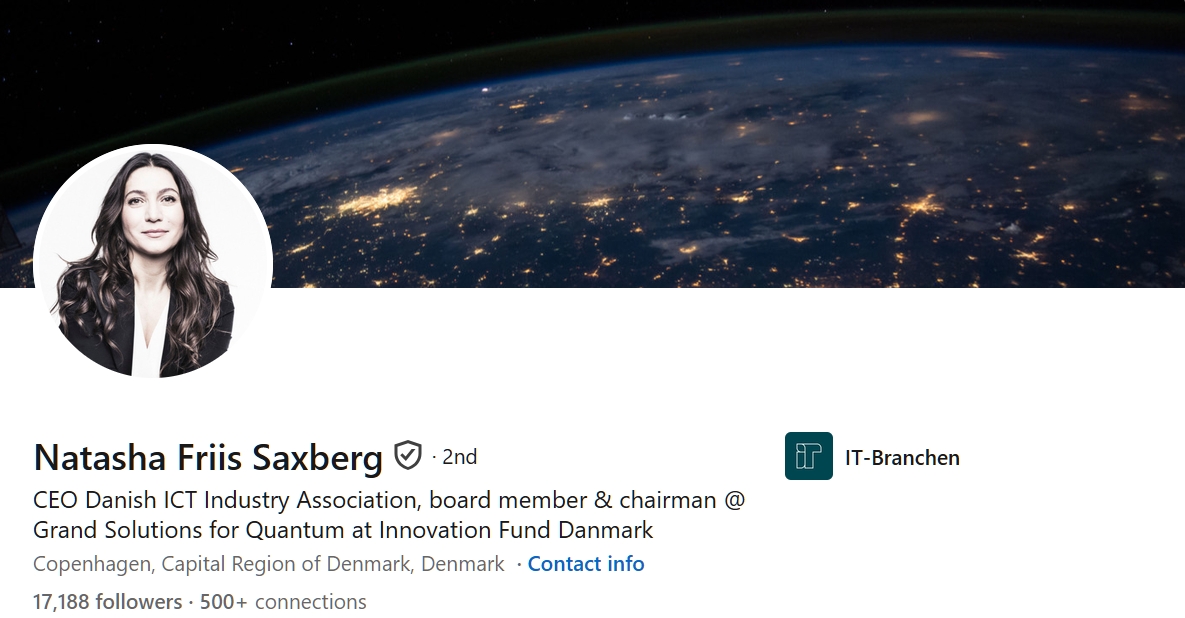
Natasha Friis Saxberg was born on July 27, 1975, and spent the early part of her technology career managing digital operations for global corporations including IBM, Sun Microsystems, and Hitachi.
Her academic foundation includes a Bachelor of Commerce in Innovation from Niels Brock, executive coursework at Harvard Business School, and a Leadership Masterclass from Copenhagen Business School.
In 2016, Natasha shifted her focus to entrepreneurial ventures, co-founding the microchip manufacturing company Lotus Microsystems, writing books on technology strategy, and joining advisory boards across the startup ecosystem.
Today, she serves as Chief Executive Officer of IT-Branchen (the Danish ICT Industry Association), deputy chairman at Innovation Fund Denmark, and a committee member for Digital Europe.
About IT-Branchen
IT-Branchen is Denmark's largest independent association for technology and digital enterprises. The organization represents more than 750 member companies, ranging from early-stage tech startups to global digital corporations, advocating for improved digital infrastructure and technology education.
LinkedIn Content Strategy Overview
Who should follow Natasha: Tech executives, policymakers, industry association leaders, and anyone tracking Danish or European tech policy
Core Value Proposition: As CEO of the Danish ICT Industry Association and chairman of Grand Solutions for Quantum at Innovation Fund Danmark, Natasha positions herself as a bridge between technology, business, and national policy. She speaks for the Danish tech sector on the national stage.
Key Themes & Topics
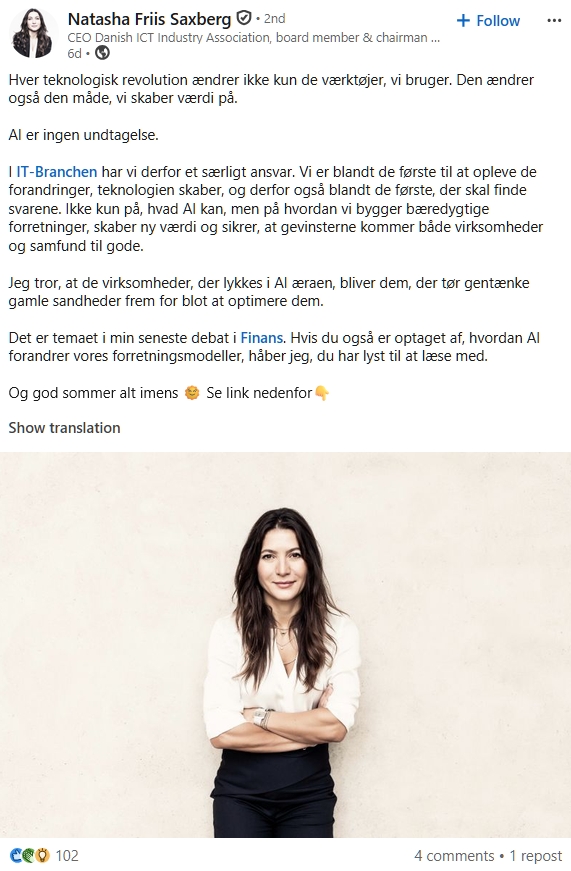
- AI's Effect on Business and Society - Her most recurring theme. Posts cover how AI reshapes business models, education choices, and workforce demand:
- The gender gap in AI experimentation and IT education
- AI's impact on which university programs students choose
- How leaders should rethink old assumptions rather than just optimize them
- Quantum Technology - Given her chairman role, she covers Denmark's quantum ambitions:
- Major fund launches and investment milestones
- Positioning quantum as the next paradigm shift after computing and mobile
- Policy and Public Debate - Heavy presence at events like Folkemødet, Denmark's political festival:
- Panel recaps on European venture capital and scaling companies
- Danish pension capital and its role in funding growth companies
- Digital sovereignty and Europe's competitiveness against the US
- Recognizing Tech Leadership - Posts around IT-Branchen's Tech CEO award and jury work, celebrating executives who combine technology with business results.
Format & Presentation Style
- Long-form narrative posts built around a central question or tension, often opening with a provocative line
- Prose over lists - she rarely uses numbered breakdowns, favoring flowing argument and personal reflection
- Heavy tagging - consistently credits panelists, ministers, and collaborators by name and company
- Event photography - multiple images per post from conferences, panels, and award ceremonies
- Selective hashtag use - reserved mostly for events like #Folkemødet, #FM26, and #itparatskibet rather than every post
Engagement Strategy
- Rhetorical questions - frequently opens or closes posts with a direct question to the audience
- Institutional voice - regularly speaks as "we" on behalf of IT-Branchen rather than purely as an individual
- Coalition building - names ministers, CEOs, and partners directly, extending reach through their networks
- Advocacy framing - consistently ties company or sector news back to national competitiveness and policy stakes
Performance Indicators
Engagement ranges widely, from under 20 reactions on quieter event recaps to 550+ on her strongest posts, with comment counts often in the single digits to high teens. One of her best recent performing posts covered the launch of Denmark's largest quantum fund, tagging ministers and investors directly. Her strongest results tend to come from major funding or policy announcements rather than routine event coverage.
Overall Strategy Summary
Natasha is building herself as a national voice for Danish tech policy, someone who translates industry developments into stakes for the country's competitiveness. Her content works less as personal branding and more as institutional advocacy, using her platform to move conversations among decision makers rather than to teach a broad following.
Jette Singleton – Chief People Officer, KMD
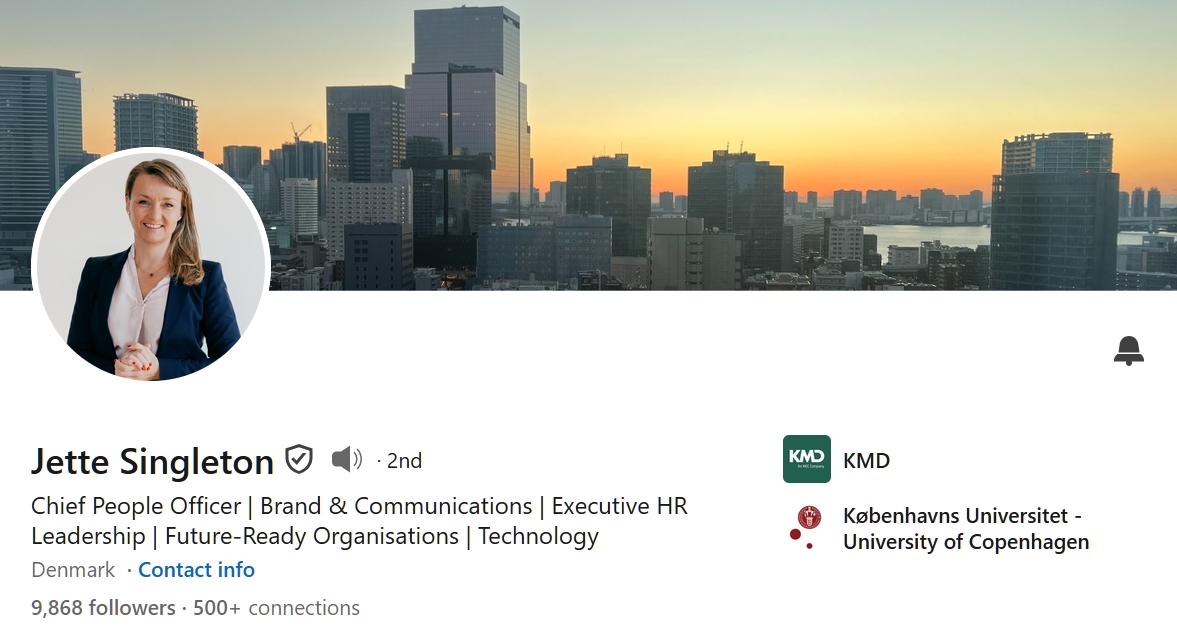
Jette Singleton earned her Master's degree in organizational psychology from the University of Copenhagen before completing executive management training at the University of Virginia Darden School of Business and INSEAD.
Over a 15-year career in human resource leadership, she built HR functions across the energy, e-commerce, and technology sectors.
Her career highlights include leading global talent programs at Ørsted, serving as HR Director at Carlsberg Group, and building the HR department during a period of hypergrowth as Chief People Officer at Hobbii.
She then stepped into the role of Senior Vice President and Head of People & Culture at the Danish IT services company KMD.
About KMD
KMD is a major Danish technology and software company that develops digital solutions for public administration, municipal services, and private sector enterprises across Scandinavia. Within KMD, Jette managed a team of 70 specialists dedicated to organizational development, communications, talent acquisition, and employer branding.
LinkedIn Content Strategy Overview
Who should follow Jette: Chief People Officers, HR leaders, executive teams, and anyone interested in organizational culture, leadership development, or the future of the HR function
Core Value Proposition: With 9,868 followers, Jette positions herself as a sharp, experienced voice on modern people leadership, translating years as CHRO to multiple CEOs into punchy, observational commentary that reframes everyday workplace moments into leadership lessons.
Key Themes & Topics
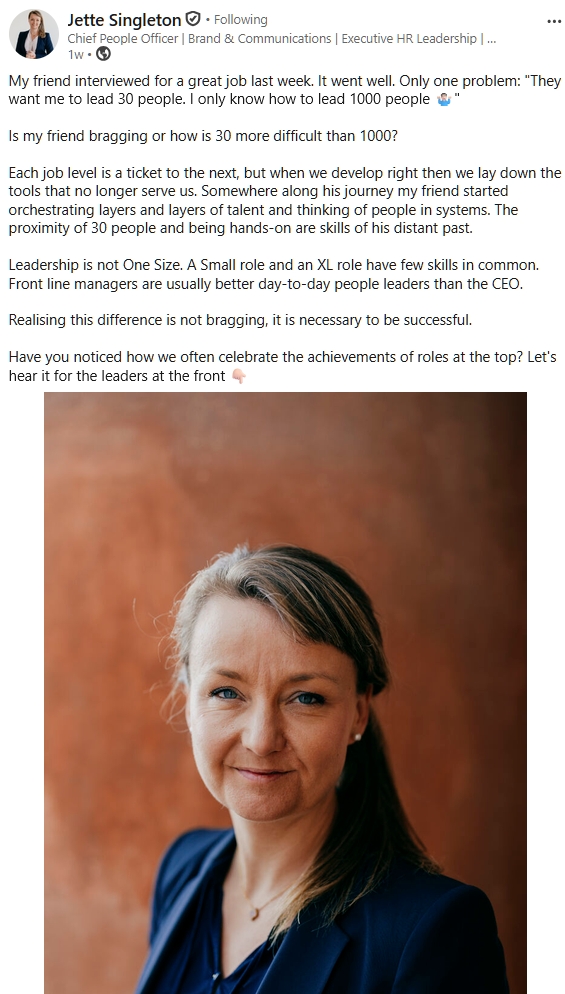
- Leadership Philosophy - Her most consistent and highest-performing pillar:
- Reframing common leadership assumptions (why leading 30 people can be harder than leading 1,000)
- The evolving executive inner circle and the rise of tech-focused roles like Chief AI Officer
- Distinguishing frontline leadership from executive leadership
- The Role and Value of HR - Direct commentary aimed at business audiences, not just HR peers:
- Why CEOs are impatient customers of HR and what actually matters to them
- Making the business case for offsites, networking, and soft skills
- Positioning HR as a translator between people initiatives and business outcomes
- Workplace Culture and Identity - Lighter, more personal observations that still carry a leadership message:
- Whether hobbies belong on a CV and what they reveal about identity
- The value of reactivating a professional network
- Representation and diversity in Danish leadership
- Talent and Hiring Practices - Practical takes drawn from her recruiting experience:
- Rehiring former employees and what it signals to the market
- What recruiters actually notice in a CV
Format & Presentation Style
- Short, punchy paragraphs with heavy line breaks for readability and scroll-stopping rhythm
- Question-driven hooks and closings that consistently invite reader response
- Bolded key phrases using stylized Unicode text for emphasis
- Minimal hashtag use - she rarely relies on tags, letting the writing carry the post
- Single supporting image per post, often simple or personal rather than corporate branding
- Conversational, almost aphoristic tone that reads more like a personal essay than a corporate update
Engagement Strategy
- Direct questions at the end of nearly every post ("Who is Lara in your business?", "What's your hobby?") that consistently drive comment volume
- Contrarian or reframing hooks that challenge a common assumption before resolving it
- Personal anecdotes (friends, lunches, walks) used as entry points into broader leadership arguments
- Tagging collaborators sparingly, reserved for events or facilitators rather than broad name-dropping
Performance Indicators
Jette consistently generates strong engagement, with many posts landing between 70 and 140 reactions and double-digit comments. One of her best recent performing posts, a piece on why CHROs need to speak the language of the business rather than HR jargon, reached over 1,000 reactions and 121 comments. Another standout, a reflective post asking whether hobbies belong on a CV, pulled in 743 reactions and over 200 comments, showing her audience responds strongly to both sharp business framing and personal, identity-driven questions.
Overall Strategy Summary
Jette has built one of the more consistently high-performing personal brands in this group by treating LinkedIn like an essay platform rather than a broadcast channel. Her formula, a reframe, a short story, and a direct question, reliably turns ordinary workplace moments into posts that outperform typical corporate thought leadership.
Bianca Bruhn – Country Director, Google Denmark
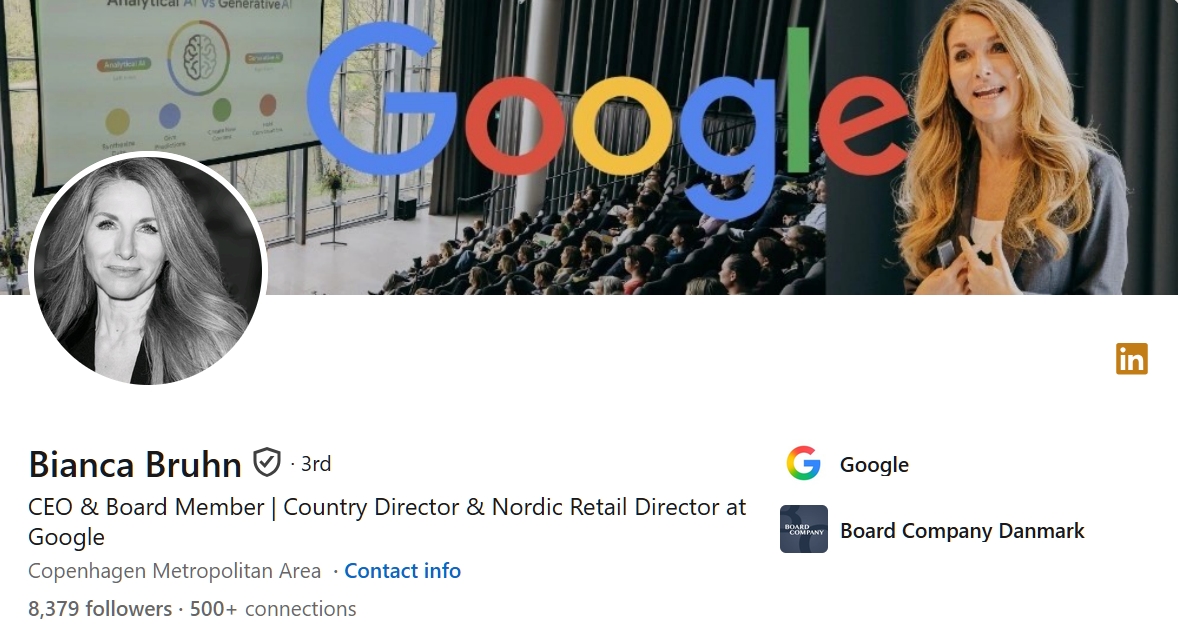
Bianca Bruhn built a career in commercial strategy and digital business management before being appointed Managing Director and Country Director of Google Denmark in September 2022.
As the head of Google's Danish division, she focuses on digital transformations, artificial intelligence deployment, and commercial partnerships across Northern Europe.
Beyond her operational responsibilities, Bianca serves on the Diversity Council, actively promoting inclusive leadership and equitable workplace initiatives throughout Denmark.
About Google Denmark
Google Denmark is the regional division of global technology company Google, focusing on commercial operations, digital literacy, and cloud infrastructure for Danish businesses and institutions. The division drives regional initiatives around AI readiness, digital skill building, and sustainable computing practices.
LinkedIn Content Strategy Overview
Who should follow Bianca: Tech and business leaders, marketing and communications professionals, and anyone interested in AI adoption, gender equity in technology, or Nordic business trends
Core Value Proposition: As CEO & Board Member and Country Director & Nordic Retail Director at Google, Bianca positions herself as a bridge between global AI innovation and Danish business and society, blending corporate thought leadership with personal, values-driven storytelling.
Key Themes & Topics
- AI and Business Transformation - Her most frequent content pillar, covering:
- Agentic commerce and Google's AI products (AI Overviews, AI Mode, AI Max)
- Enterprise AI adoption data and Google Cloud earnings updates
- Danish companies implementing AI (Danfoss, Trustpilot, Arla Foods)
- Women in AI and Leadership - A strong secondary focus tied closely to her personal mission:
- The gender gap in Denmark's AI workforce and AI skills
- The Reimagine campaign encouraging women to engage with AI tools
- Advocacy for female founders and leaders in tech
- Personal Leadership Philosophy - Reflective posts on her own career and identity:
- Career journey from rural Denmark to global tech leadership
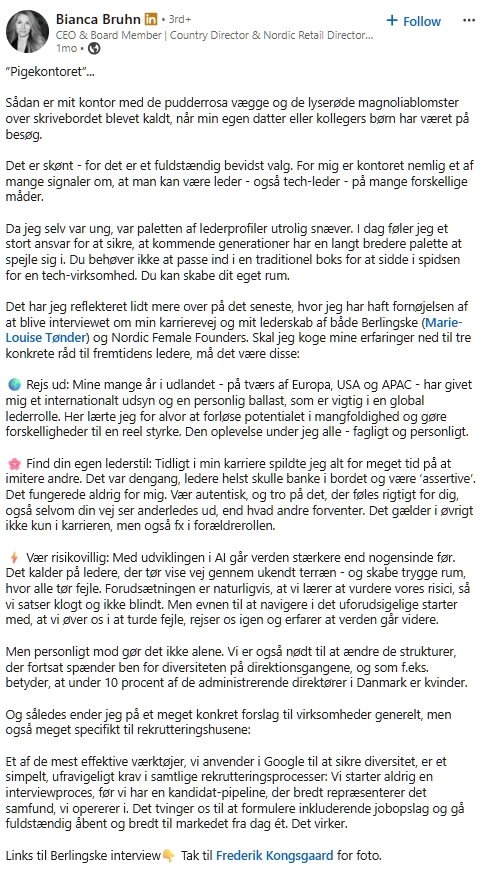
- Authenticity and rejecting traditional "assertive" leadership molds
- Milestone reflections, including a widely shared post marking her 50th birthday
- Danish Society and Culture - Commentary connecting her professional role to national conversations:
- Democracy and youth engagement at Folkemødet
- Historical representation of women in public spaces
- Media and creator economy shifts (YouTube replacing traditional TV)
Format & Presentation Style
- Long-form narrative posts that mix personal anecdotes with business data and statistics
- Bilingual content - she writes in both Danish and English depending on the audience and occasion
- Heavy use of emojis to break up sections and add warmth to otherwise corporate topics
- Photo-supported posts - nearly every post includes event photos, portraits, or campaign visuals
- Extensive tagging of colleagues, partners, and organizations, often crediting entire teams by name
- Hashtag clusters at the end of posts (mixing Danish and English tags like #AI, #Ligestilling, #GoogleCloud)
Engagement Strategy
- Event-driven posting - most content ties back to a conference, summit, or public appearance she participated in
- Personal vulnerability - her highest-performing posts lean into personal milestones and authenticity rather than corporate messaging
- Collaborative credit - she consistently name-checks partners, journalists, and teammates, which encourages those tagged to engage and share
- Cause alignment - gender equity and AI accessibility themes generate strong comment threads, especially around International Women's Day
Performance Indicators
Her posts generate solid engagement in the range of 100 to nearly 400 reactions, with comments typically in the single to low double digits. One of her best recent performing posts, a deeply personal reflection marking her 50th birthday, broke well past her usual numbers with over 800 reactions and more than 160 comments, far outperforming her corporate AI updates.
Overall Strategy Summary
Bianca is building a dual identity on LinkedIn: a credible voice on enterprise AI adoption in the Nordics, and a personal advocate for authentic, values-led leadership. The data suggests her audience responds most strongly when she steps away from product talk and into vulnerable, story-driven content, a signal that her personal narrative may be her most underused growth lever.
Gine Maltha Kampmann – Executive Director, EQUALIS
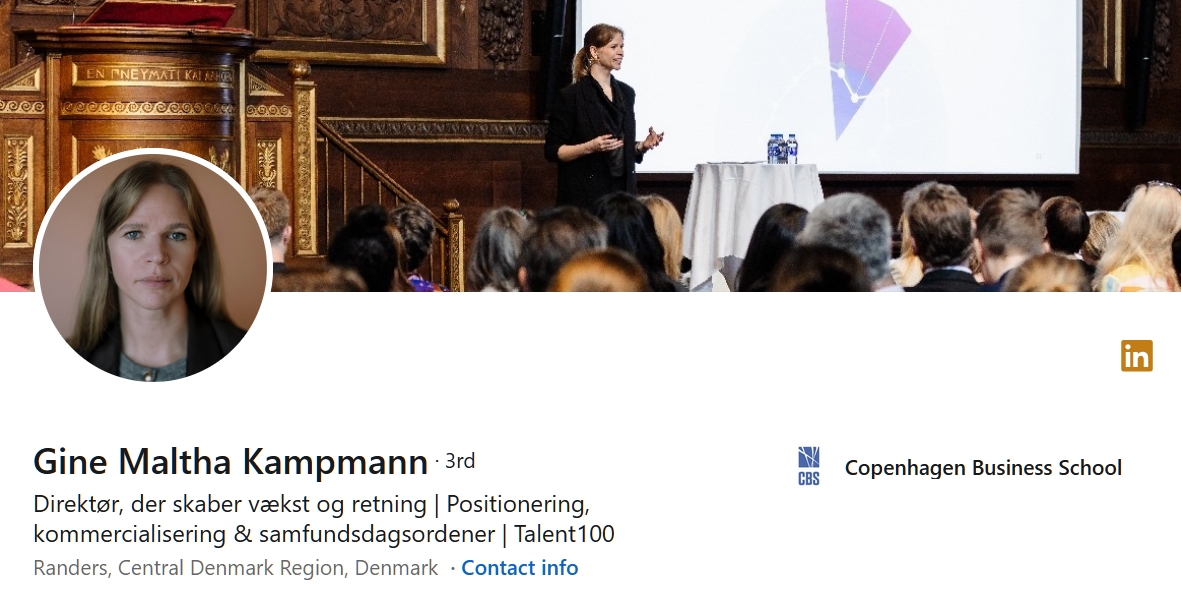
Gine Maltha Kampmann built a management career in industrial companies and management consulting before dedicating her focus to labor market equality.
She took on the leadership of EQUALIS, an independent, non-profit Danish think tank focused on gender diversity and equal opportunity in the workplace.
In addition to leading EQUALIS, Gine serves on the Board of Directors at the Institute for Human Rights and acts as an appointed Danish expert on the European Union's Strategic Advisory Group on Gender Equality.
She also advises several startup advisory boards and research panels across Denmark.
About EQUALIS
EQUALIS is a Copenhagen-based politically independent think tank that conducts data-driven research to promote gender equality across the labor market and entrepreneurship ecosystems. The think tank produces the annual Diversitetsbarometer, measuring gender balance across 22 specific economic and employment indicators in Denmark.
LinkedIn Content Strategy Overview
Who should follow Gine: HR and DEI leaders, policymakers, business executives, and anyone interested in Danish labor market equality, parental leave policy, or workplace talent structures
Core Value Proposition: As a director working at the intersection of business and equality policy, Gine positions herself as a data-driven, evidence-based voice on parental leave, talent access, and gender equity in the Danish workplace, translating research and statistics into concrete policy arguments.
Key Themes & Topics
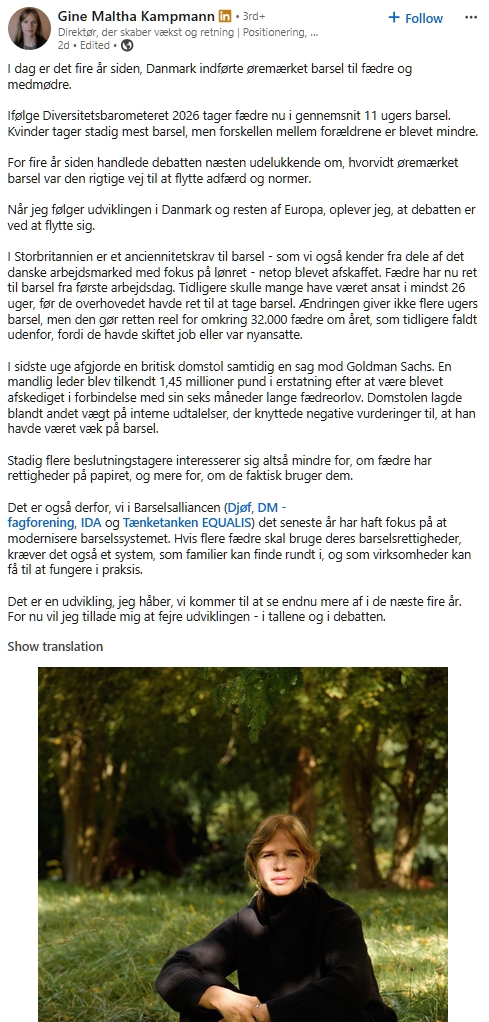
- Parental Leave Policy - Her most consistent and detailed content pillar:
- Analysis of father-specific ("earmarked") parental leave and its effects on norms
- Coverage of legal cases and international policy shifts, including UK reforms
- Critiques of Denmark's parental leave reimbursement system and its administrative burden on smaller companies
- Gender Equity in Career Progression - Frequent commentary tied to hard data:
- The long-term career penalty parents, especially mothers, face after having children
- Proximity bias and how office visibility unfairly disadvantages remote or part-time workers
- Statistics on how leave impacts career development differently for men and women
- Talent Access and Inclusion - Broader workplace structure commentary:
- How companies unknowingly exclude parts of the talent pool
- Case studies of companies doing systematic, sustained diversity work
- The role of networks, relationships, and access in career advancement
- Public Debate and Media Commentary - Frequent documentation of her public role:
- TV appearances discussing new research on paternity leave
- Op-eds co-authored with other organizations in outlets like Børsen
- Appearances at Folkemødet and policy forums like Christiansborg events
Format & Presentation Style
- Danish-language, policy-brief style posts dense with statistics and specific figures
- Structured argumentation - posts typically state a fact, provide data, then build toward a policy recommendation
- Minimal emoji use compared to peers, reflecting a more formal, analytical tone
- Frequent co-branding with think tank EQUALIS and coalition partners like Djøf, DM, and IDA
- Photo documentation of speaking engagements, panels, and media appearances
- Comment-thread links - she often points readers to full articles or reports in the comments rather than the post itself
Engagement Strategy
- Coalition amplification - regularly co-posts or references joint work with union and think tank partners, widening reach
- Data as a hook - opens many posts with a striking statistic to draw readers in
- Contrarian framing - challenges popular workplace advice (like "be visible to your boss") with research-backed counterarguments
- Timely news pegs - ties posts to recent court rulings, new reports, or policy anniversaries to stay relevant
Performance Indicators
Her posts generate solid, steady engagement, generally ranging from 100 to around 250 reactions with active comment threads. One of her best recent performing posts, an op-ed pushing back against advice that employees should be strategically visible in the office, stood out well above her average with 791 reactions, showing that contrarian, research-backed takes on management practices resonate far beyond her usual parental leave policy audience.
Overall Strategy Summary
Gine has built a credible policy-analyst voice on LinkedIn, using data and coalition partnerships to drive concrete conversations about parental leave and workplace equity rather than general leadership commentary. Her strongest content suggests that when she extends her sharp, evidence-based style beyond parental leave into broader management critique, she reaches an even wider and more engaged audience.
Katrine Bach – Co-founder & CEO, Connected Women in AI
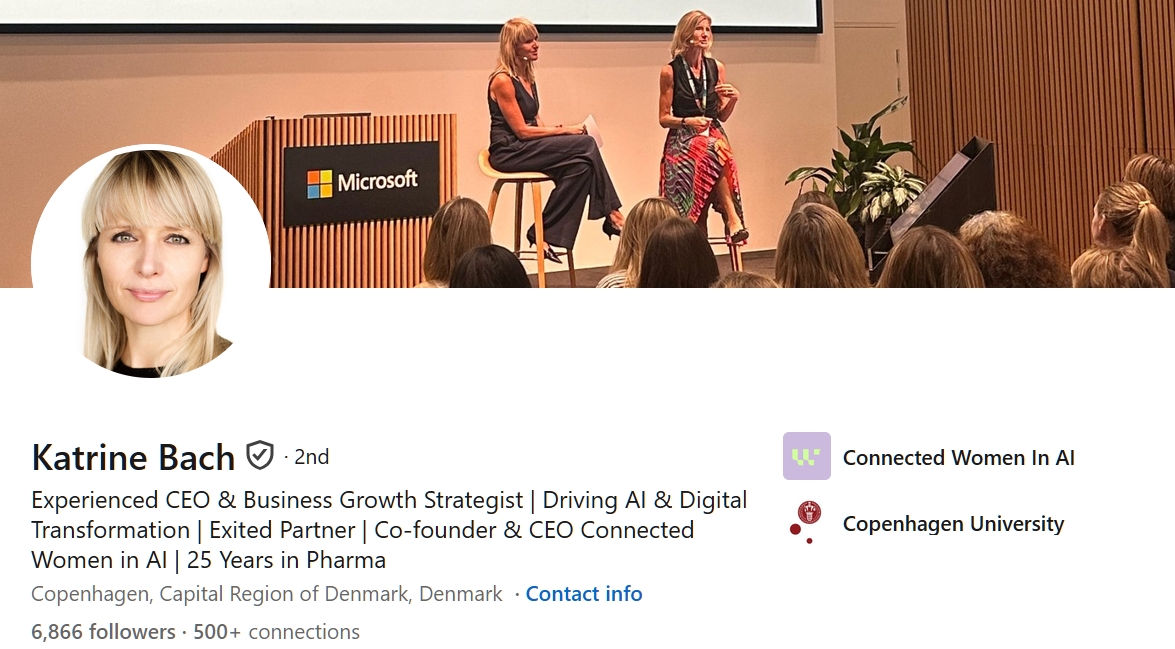
Katrine Bach worked for 25 years as an executive and growth strategist in the pharmaceutical industry, leading digital transformation initiatives and commercial expansion programs.
Throughout her career in healthcare and technology, she focused on how organizations adopt new digital tools and talent processes.
Observing that corporate artificial intelligence deployment often stumbles due to lack of workforce participation rather than technical capability, she co-founded Connected Women in AI (CWAI).
As CEO, she guides organizations to unlock talent potential by building broader workforce engagement with artificial intelligence.
About Connected Women in AI
Connected Women in AI is an international community and learning platform originating in Denmark that connects, upskills, and visible-izes female talent in artificial intelligence. The platform offers learning modules, mentorship programs, and conference directories, with individual membership priced at 39 DKK per month or 365 DKK annually.
LinkedIn Content Strategy Overview
Who should follow Katrine: AI leaders, DEI and HR professionals, pharma and business executives, and anyone tracking how AI adoption unfolds unevenly across gender and organizational lines
Core Value Proposition: As Co-founder and CEO of Connected Women in AI and a business growth strategist with 25 years in pharma, Katrine positions herself as a research-driven voice on who gets left behind in AI adoption and why, backing her commentary with original studies and public advocacy.
Key Themes & Topics
- AI Adoption and Inclusion Research - Her dominant content pillar, built on original data:
- Findings from Connected Women in AI's research with Ipsos Denmark on gender gaps in AI use
- Commentary on manager encouragement as a key predictor of AI adoption
- Studies on bias against women using AI tools professionally
- Connected Women in AI Advocacy - Ongoing promotion of her organization's initiatives:
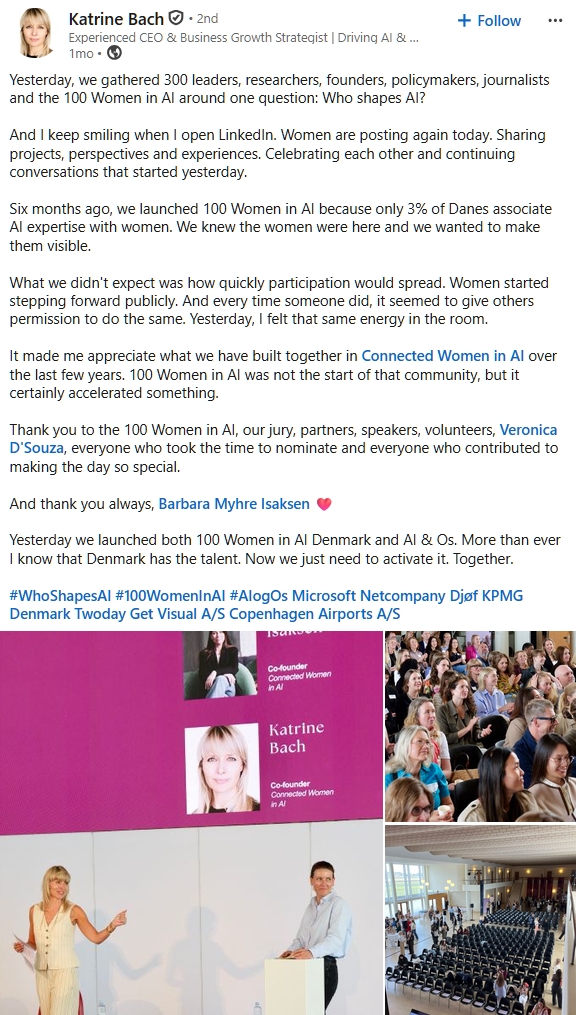
- The "100 Women in AI" role model campaign with Microsoft and Netcompany
- The "AI & Os" podcast featuring conversations with tech and business leaders
- Reports such as "The Uneven Transition"
- Public Speaking and Media Appearances - Regular documentation of her visibility:
- Panel appearances at Folkemødet on AI, talent, and the labor market
- National television appearances, including TV 2's Go' morgen Danmark
- Event schedules shared ahead of time to drive attendance
- Personal and Health Advocacy - Occasional posts that step outside her AI focus:
- A personal breast cancer disclosure tied to joining an early detection app's advisory board
- A request to her network for help finding her daughter an apartment
Format & Presentation Style
- Bilingual posting - she moves fluidly between Danish and English depending on the audience
- Data-backed narrative - posts frequently reference specific studies, percentages, or survey findings rather than general opinion
- Reposts of her organization's content - regularly amplifies Connected Women in AI's own page posts
- Event logistics included - shares exact times and locations for panels and appearances
- Personal photos and screenshots - uses a mix of personal photos, event images, and graphic slides
- Hashtag use - lighter than some peers, often just one or two campaign-specific tags
Engagement Strategy
- Institutional credibility - she consistently ties her personal commentary back to research from Connected Women in AI and partners like Ipsos
- Cross-promotion - leverages her nonprofit's page, podcast, and campaign pages to reinforce her personal posts
- Community reciprocity - tags collaborators and co-panelists to widen reach
- Vulnerability as connector - personal, non-AI posts create a different, often stronger kind of engagement than her research content
Performance Indicators
Her research and advocacy posts typically perform strongly, generating anywhere from 100 to over 400 reactions with double-digit comment counts. One of her best recent performing posts, a personal disclosure about her breast cancer diagnosis tied to a health advocacy partnership, significantly outpaced her usual numbers with over 500 reactions and nearly 40 comments, underscoring how personal openness can outperform even her strongest data-driven content.
Overall Strategy Summary
Katrine has built a research-backed thought leadership platform around AI equity, using Connected Women in AI as both a credibility engine and a content amplifier. While her data-driven posts are the backbone of her strategy and build sustained authority, the rare moments she opens up personally reveal an even stronger, largely untapped source of connection with her audience.
Marianne Andersen – Founder & CEO, High5Girls
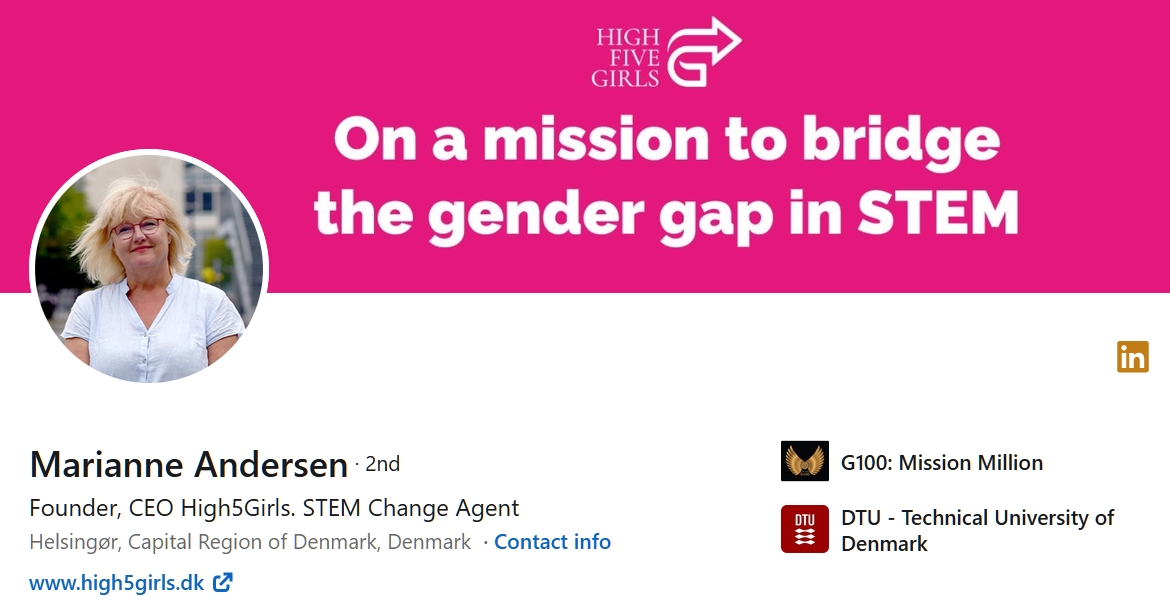
Marianne Andersen studied low-voltage electronics engineering at university, where she was the only female student in a class of 32 men.
She then spent 25 years working in global medtech, robotics, and artificial intelligence corporations before founding her own consulting ventures.
Driven by a desire to change STEM gender ratios, Marianne founded the non-profit organization High5Girls in 2018.
Her work in empowering young women in technology earned her the Agnes and Betsy Award in 2020, an honor awarded to engineers making significant contributions to tech diversity.
About High5Girls
High5Girls is a Danish non-profit NGO that organizes hands-on technology camps, hackathons, and role model programs for girls aged 13 to 19. In a single year, the organization hosted 16 camps and 5 hackathons supported by university partners, with independent evaluations confirming sustained participant engagement.
LinkedIn Content Strategy Overview
Who should follow Marianne: STEM educators, diversity and inclusion professionals, corporate sponsors of youth programs, and parents interested in girls' education in technology and science
Core Value Proposition: As Founder and CEO of High5Girls, Marianne positions herself as a grassroots STEM Change Agent, mobilizing role models, mothers, schools, and corporate partners to close the gender gap in technology and science education across Denmark.
Key Themes & Topics
- Role Model and Community Building - Her most consistent content pillar, documenting:
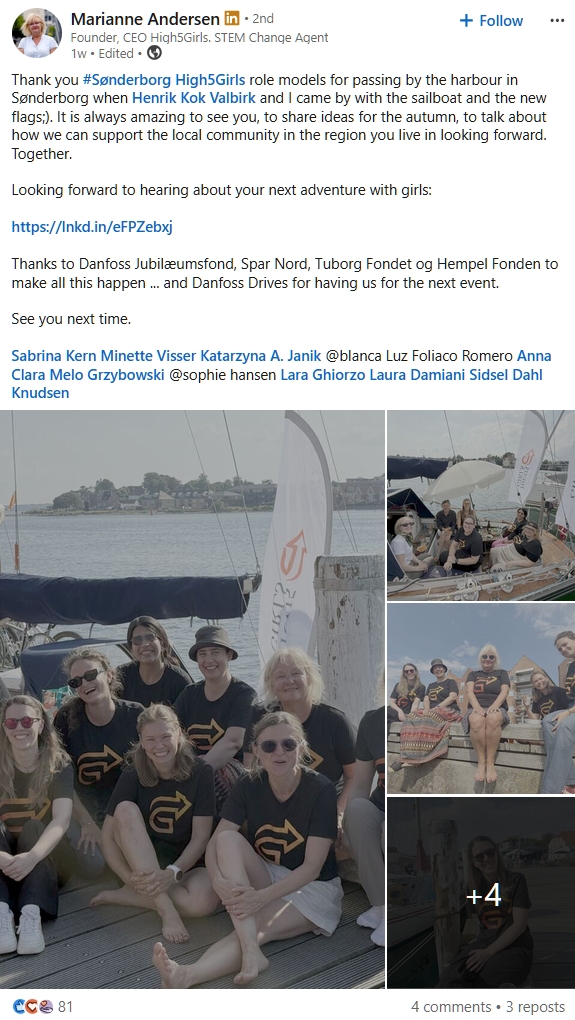
- Regional High5Girls events with volunteer role models across Danish cities
- Recruitment and appreciation posts thanking role models by name
- Community gatherings such as harbor visits and annual parties
- Mother-Daughter STEM Programming - A recurring format specific to her organization's approach:
- Coding and AI workshops designed for mothers and daughters together
- Framing mothers as the primary influence on daughters' career choices
- Hands-on activities like coding robots or AI-controlled games
- Gender Bias in STEM Advocacy - Opinion driven content addressing systemic issues:
- Co-authored op-eds on unconscious bias against women in technical roles
- Commentary on women being steered away from technical work toward "glue-work"
- Statistics on the underrepresentation of women in STEM careers
- Youth Entrepreneurship and Education - Broader engagement with the Danish education ecosystem:
- Judging student entrepreneurship competitions
- Partnerships with universities like DTU and organizations like Fonden for Entreprenørskab
Format & Presentation Style
- Bilingual posts - a mix of Danish and English depending on the event and audience
- Photo-heavy documentation - nearly every post includes multiple event photos with credited photographers
- Extensive personal tagging - she consistently names and links role models, partners, and sponsors
- Sponsor and grant acknowledgment - regularly credits funding bodies like Tuborg Fondet, Danfoss Jubilæumsfond, and Code4Europe grants
- Community voice quotes - often includes direct quotes from role models or participants to add authenticity
- Hashtag clusters covering STEM, volunteering, and gender equality themes
Engagement Strategy
- Gratitude driven posting - a large share of content is dedicated to thanking volunteers, sponsors, and partner organizations
- Local and grassroots framing - posts are tied to specific cities and events rather than broad campaigns
- Credibility through data and co-authorship - opinion pieces are strengthened by partnering with academics and publishing in outlets like Børsen
- Direct calls to action - she frequently invites people to sign up daughters, nieces, or students directly through links or contact details
Performance Indicators
Most of her posts generate modest but steady engagement, typically ranging from 10 to around 100 reactions, reflecting an engaged niche community rather than viral reach. One of her best recent performing posts, an op-ed on unconscious bias pushing women in STEM toward non-technical roles, stood out well above her usual numbers with 370 reactions and 13 comments, showing that advocacy content with a clear systemic argument resonates far more than event recaps.
Overall Strategy Summary
Marianne uses LinkedIn primarily as a mobilization and gratitude tool for High5Girls rather than a personal branding platform. Her steady stream of event documentation builds community trust and keeps sponsors visible, but her advocacy pieces on gender bias in STEM consistently outperform everything else, suggesting real opportunity to lean further into opinion led thought leadership alongside her grassroots reporting.