

Written by

You're already on LinkedIn. You're posting, engaging, building. But are you truly making the most of it?
We used ChatGPT to evaluate hundreds of Australian C-level executives on content consistency, engagement quality, and genuine thought leadership.
These 10 rose to the top. They're not just accumulating followers, they're sparking real conversations, sharing hard-won insights, and showing up with purpose every single time.
Study what they do, borrow what works, and take your LinkedIn game to the next level.
Ready to make it happen? Start your free trial with Will - your AI LinkedIn strategist, straight from WhatsApp.
Cliff Obrecht – Founder And COO, Canva
Cliff Obrecht did not start his professional journey in a high-rise office.
He began by helping his partner, Melanie Perkins, print school yearbooks from a living room in Perth.
They shared a common frustration with the high cost and complexity of existing design software for average users. This specific drive to democratize creativity led to the official birth of Canva.
Today, Cliff manages the operational engine of a global design giant. He maintains the grounded perspective of a founder who remembers the struggle of the early days clearly.
His focus remains on building a company that acts as a force for good while scaling to meet global demand.
About Canva
Canva is a global visual communication platform that enables anyone to design anything. As of 2025, the company has reached 260 million active monthly users and generated $3.5 billion in annual revenue.
The platform is currently used in 190 countries and has seen its user base grow three times over since 2021. The organization employs thousands of people across the globe to support its mission of making design accessible to every person on the planet.
LinkedIn Content Strategy Analysis
Who should follow Cliff: Designers, creative professionals, marketers, SaaS founders, product builders, and anyone following the intersection of AI and design tools.
Core Value Proposition: Cliff uses LinkedIn as an extension of Canva's product narrative. As co-founder and COO, he has a rare vantage point on a company that is actively reshaping creative software, and his posts function as a signal to the design and tech world of what Canva is building and why it matters.
Key Themes & Topics
- Product Announcements and Acquisitions - The core of his original content. When Canva acquires a company or launches something significant, Cliff posts directly about it with context that only a founder can provide. One of his best recent performing posts announced the welcome of two new teams (Cavalry and MangoAI) to Canva, drawing over 3,000 reactions and framing both acquisitions around a single, coherent creative vision.
- AI and the Future of Creative Work - A thread running through much of his content. Cliff frequently surfaces Canva's positioning as an AI-native platform, drawing lines between acquisitions, partnerships (with OpenAI, Claude, Runway), and the broader design industry shift away from legacy tools like Adobe.
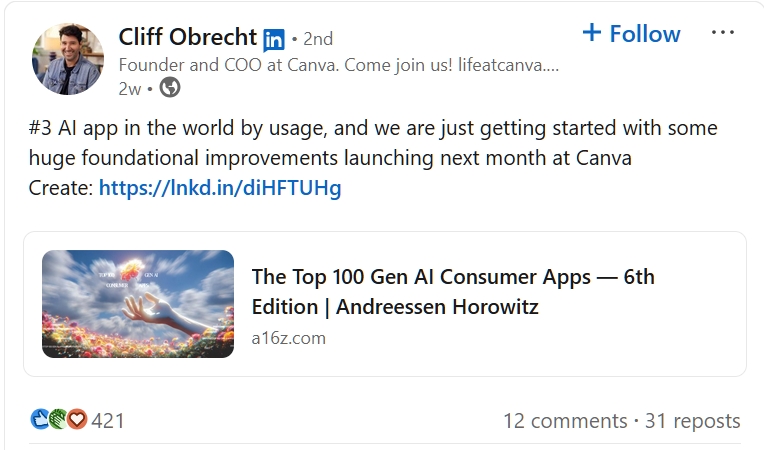
- Industry Validation and Market Signals - Short, confident posts linking to external reports that validate Canva's momentum. A brief post noting Canva's ranking as the #3 AI app in the world by usage drew over 400 reactions with minimal text, letting the data speak.
- Personal Transparency and Physical Challenges - Occasionally, Cliff steps entirely outside the product frame. One of his best recent performing posts was about committing to a 10km-per-day physical endurance challenge, framing it around resilience and doing something bigger than yourself. It drew 435 reactions and showed a different, more personal side.
Format and Presentation Style
Cliff's own posts tend to be short and direct, sometimes just one or two sentences alongside a link or image. He does not over-explain. When the news is big, the post stays lean. He also amplifies posts from Canva colleagues, adding a brief sentence of his own that signals endorsement and pulls the content into his network. Hashtags appear occasionally but are not a heavy feature of his style. The overall impression is executive confidence, not content marketing.
Engagement Strategy
Cliff's follower count and LinkedIn Influencer status mean his posts reach an audience well beyond his connections. He does not use a consistent call to action or newsletter integration. The engagement he earns tends to come from the weight of the news rather than storytelling mechanics. When he speaks, people listen because his words carry real company authority. Reposts from colleagues working on specific Canva features serve as a light-touch amplification strategy.
Performance Indicators
Cliff's posts generate substantially higher engagement than most operators at his level, ranging from around 100 to 3,000+ reactions. Acquisition and major product posts consistently outperform. Posts with external validation (market rankings, analyst reports) also perform well. More personal posts, including the endurance challenge and motivational framing, punch above their weight relative to how brief they are. He has around 45,000 followers.
Overall Strategy Summary
Cliff's LinkedIn strategy works because it is anchored in genuine news rather than engineered content. He does not appear to be trying to build a personal brand in the conventional sense. Instead, his posts reflect the rhythm of actually running a company at scale during a moment of major industry disruption. That authenticity, paired with the gravity of what Canva is doing in the market, makes his feed genuinely worth following for anyone who wants to understand where creative tools are heading.
Matt Fickling – COO, Motto Motto Group
Matt Fickling is a leader who understands that a great brand is built on the plate and in the fine details of a franchise agreement.
He joined Motto Motto with a specific mission to take Japanese casual dining to every corner of Australia.
Matt treats every restaurant opening like a major community event. He focuses on the local neighborhood to ensure long-term loyalty from the first day of operations.
His approach involves a deep commitment to operational excellence and transparency. He believes that the success of a franchise depends on the success of the individual partners who run the locations.
About Motto Motto Group
Motto Motto is a Japanese kitchen concept that focuses on high-quality ingredients like wagyu beef and sashimi-grade salmon. Their Townsville launch set significant records with over $350,000 in first-month sales.
The brand saw more than 1,200 locals register for their loyalty program before the doors even opened for the first time. The company continues to expand its footprint across Australia by focusing on premium casual dining experiences.
LinkedIn Content Strategy Analysis
Who should follow Matt: Franchise operators, QSR leaders, hospitality professionals, food entrepreneurs, and anyone interested in the building of an Australian restaurant brand.
Core Value Proposition: Matt positions himself as an operator-builder, using LinkedIn to tell the ongoing story of Motto Motto Japanese Kitchen's growth across Australia. His posts blend personal pride in the brand with genuine warmth for franchise partners, teams, and the communities they serve.
Key Themes & Topics
- Brand Milestones and Expansion - The backbone of Matt's feed. He marks new store openings, award nominations, franchise partner welcomes, and network growth with consistent energy. These posts serve as both celebration and quiet recruitment.
- Menu and Product Launches - Food-first content that shows real enthusiasm, not just marketing speak. His new menu day post ("I ABSOLUTELY LOVE LOVE LOVE LOVE NEW MENU DAY") and his Bento Box write-up read like someone who genuinely enjoys what he's selling.
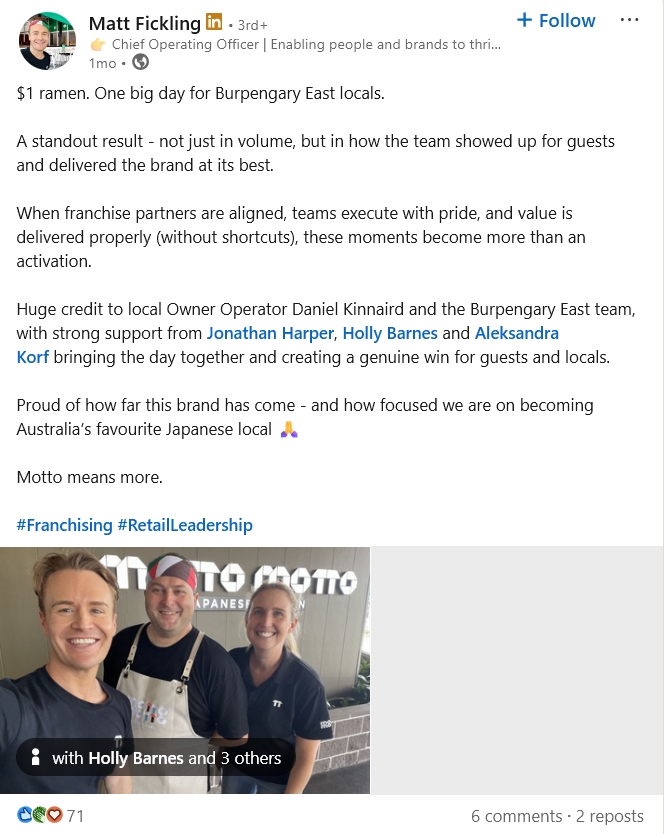
- People and Culture - Matt consistently shines a spotlight on franchise partners by name, praising their execution and commitment. Posts crediting local operators like Daniel Kinnaird or Miku and Dylan land well because the recognition feels personal, not formulaic.
- Operational Pride and Brand Purpose - Posts framing day-to-day execution (like $1 Ramen Days) through the lens of what makes a franchise network strong. He uses these moments to articulate values around quality, team alignment, and guest experience.
Format and Presentation Style
Posts tend to be short-to-medium length with clear energy and clean paragraph breaks. Matt uses brand-specific catchphrases deliberately ("Motto means more") as recurring anchors. He leans heavily on images and video to bring store openings and activations to life. Hashtag use is consistent but targeted, mixing brand-specific tags like #MottoMotto with broader industry terms like #Franchising and #QSR. Posts are often tagged to the Motto Motto Group company page, reinforcing brand reach alongside personal reach.
Engagement Strategy
Matt's approach is community-first: he tags specific team members and franchise partners, links to earned media coverage, and lets celebration do a lot of the strategic work. He avoids hard sells. The posts that attract the most engagement tend to combine a genuine human moment with brand momentum, such as one of his best recent performing posts announcing the appointment of two new marketing hires, which framed a staffing update as a story about connection and the next chapter of brand growth.
Performance Indicators
Posts generate engagement in the 15 to 131 reactions range, with the strongest posts pulling 9 to 16 comments. Higher-performing posts tend to feature personal acknowledgment of people or milestone moments tied to brand growth, while more transactional menu posts land lighter. Matt has around 12,963 followers.
Overall Strategy Summary
Matt is building a brand story in public, using his personal profile as a behind-the-scenes channel for Motto Motto's Australian expansion. It works because he posts like an operator who cares rather than a marketer who posts. The strategy is less about thought leadership and more about building a visible, human record of a franchise system growing up, which over time could become a useful tool for franchise recruitment, media attention, and industry credibility.
Matt Comyn – CEO, Commonwealth Bank Of Australia
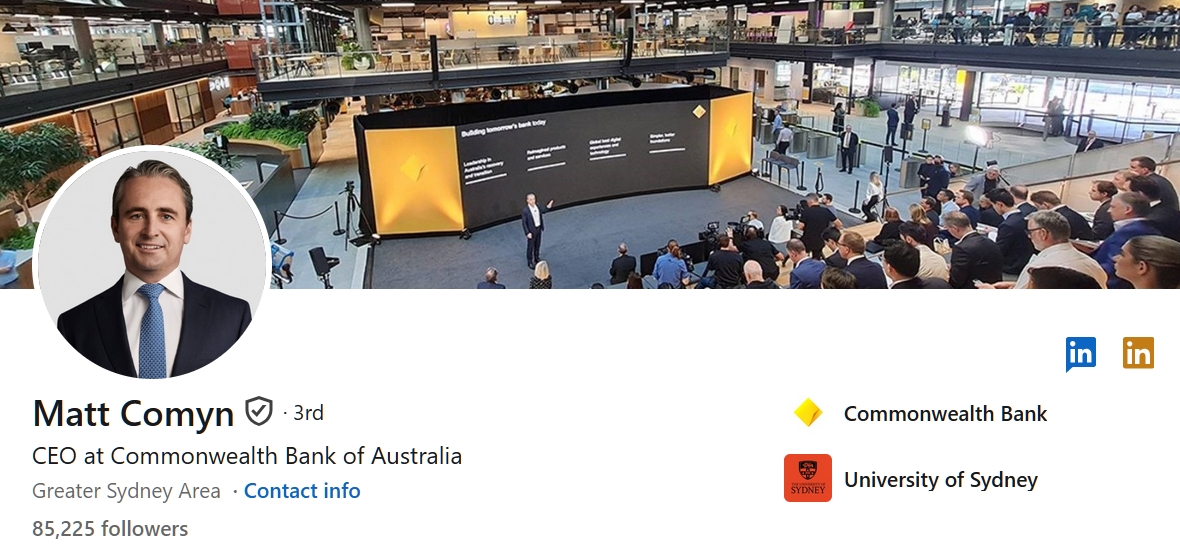
Matt Comyn took the helm of Australia’s largest bank during a period of intense scrutiny for the entire financial sector.
He addressed the challenge directly by leaning into technology and transparency.
Under his leadership, the bank has transitioned from a traditional lender into a tech-forward institution that competes with global fintech firms.
Matt prioritizes long-term technology investment over short-term market expectations.
He recently committed to hiring 2,000 IT engineers and boosting annual investment spend by $300 million to ensure the bank remains at the cutting edge of digital services.
About Commonwealth Bank Of Australia
Commonwealth Bank is the leading provider of integrated financial services in Australia. For the 2025 financial year, the bank reported a cash net profit after tax of $10.3 billion and a net interest margin of 2.08%.
They currently serve over 16 million customers globally. The bank is recognized for its significant investment in artificial intelligence and digital banking infrastructure to improve customer outcomes.
LinkedIn Content Strategy Analysis
Who should follow Matt: CBA customers, banking industry professionals, fintech watchers, policy makers, and anyone interested in how a major Australian institution thinks about technology, community, and its role in the broader economy.
Core Value Proposition: Matt has built a strong platform as the human face of Australia's largest bank. His posts strike a consistent balance between institutional transparency and genuine community connection, positioning CBA as a bank that is deeply invested in the lives of the Australians it serves, not just in their finances.}
Key Themes & Topics
- AI & Technology in Banking - The dominant theme across his recent posts. Matt writes about CBA's AI transparency report, its partnership with Apate.ai to deploy AI-powered scam-fighting bots, its Seattle Tech Hub, and practical AI applications across the bank. He frames AI as a tool for customer protection and service improvement, making complex technology feel relevant and reassuring to a broad audience.
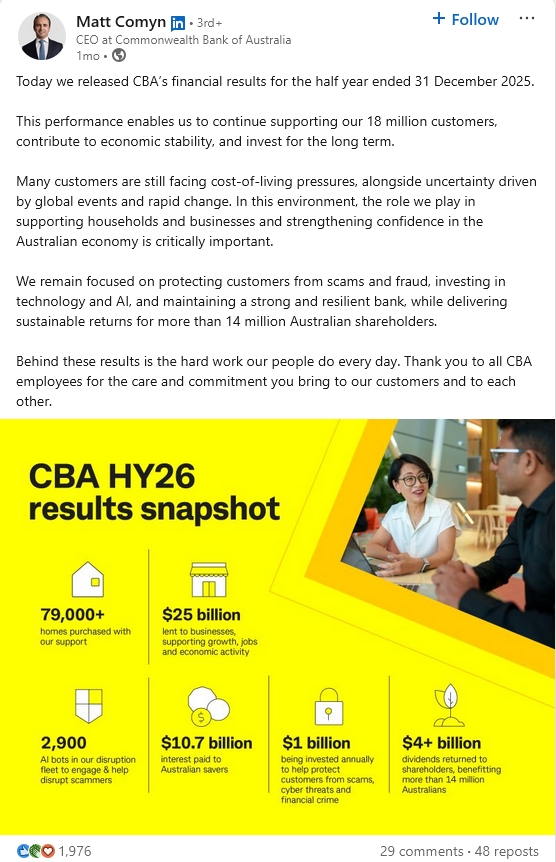
- Financial Results & Corporate Milestones - Posts around CBA's half-year and full-year results, CommSec's 30th anniversary, and the Football Australia partnership extension are delivered with clarity and purpose. By writing these in his own voice, Matt makes corporate announcements feel more personal and accessible than a standard press release ever could.
- Regional Customer Visits - One of the most distinctive and appealing elements of his content. Matt regularly posts about visiting customers in Toowoomba, Townsville, Port Macquarie, Geelong, and regional Victoria. These posts are warm, specific, and signal that leadership genuinely listens beyond head office. They are some of his most engaging content.
- Community & Social Issues - Posts covering domestic violence and financial abuse, cancer fundraising through Can4Cancer, Cyclone Alfred emergency response, and the Bondi terrorist attack memorial show a leader who understands that a bank's responsibilities extend well beyond the balance sheet.
Format & Presentation Style
Matt writes with clarity and care. His posts are considered and well-structured, reflecting the weight of the role he holds. Photos are professional and grounded in real moments, whether a visit to a regional branch or a community event. He keeps his content focused and free of noise, with no hashtags and purposeful tagging, which gives each post a sense of intent rather than habit.
Engagement Strategy
Matt's approach is deliberate rather than high-volume. With 25 posts in the dataset, each one carries weight and purpose rather than contributing to feed clutter. His content is well-matched to an audience of professionals and stakeholders who value substance over frequency. The broadcast style suits his role, and the authenticity of the regional visit posts in particular shows a leader comfortable letting real experiences speak for themselves.
Performance Indicators
With over 85,000 followers, Matt commands a substantial and engaged audience for an Australian banking CEO. His strongest posts tend to combine institutional transparency with a community-focused framing, a formula that resonates well with both professional and general audiences. One of his best recent performing posts brought together CBA's financial results with a clear acknowledgment of cost-of-living pressures, showing an ability to connect corporate performance to real people's lives.
Overall Strategy Summary
Matt's LinkedIn reflects the qualities you would want in a CEO of a major institution: measured, trustworthy, and genuinely connected to the communities the bank serves. His content does not chase trends or post for the sake of it, and that restraint feels right for the platform role he has carved out. The regional visit posts and community content are where his personality comes through most naturally, and they are among the most compelling leadership content being produced by any Australian banking executive on LinkedIn.
Peter Deans – Co-Founder And CEO, Shelf Labs}
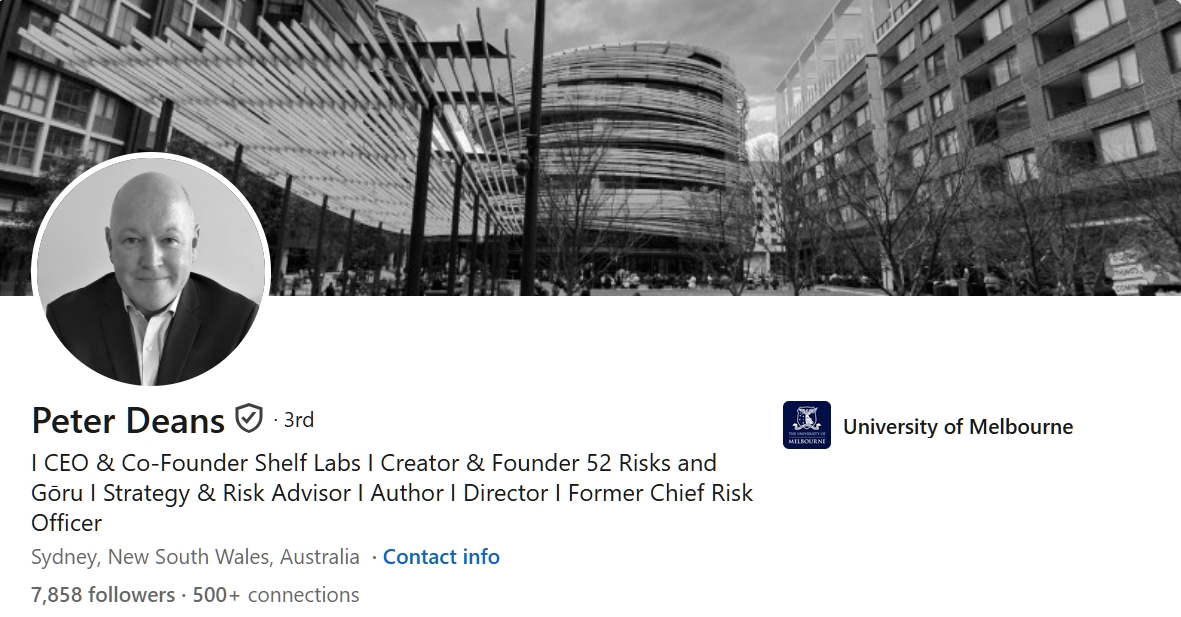
Peter Deans spent years as a Chief Risk Officer at major banks and saw firsthand how difficult it was for small businesses to manage complex regulations.
He decided to leave the corporate world to solve this problem himself.
With the launch of Shelf Labs, he is using artificial intelligence to give small and medium enterprises the kind of tools that were previously only available to giant corporations.
He combines the institutional memory of a veteran executive with the agile mindset of a startup founder. His work focuses on helping businesses navigate the complexities of modern governance and compliance.
About Shelf Labs
Shelf Labs creates intelligent software designed to help SMEs thrive in a regulated environment. Their primary product, Shelf GRC, uses artificial intelligence to suggest improvements for governance, risk, and compliance.
The company focuses on keeping humans in control while leveraging cutting-edge technology to reduce costs for smaller firms. It aims to democratize access to high-level risk management strategies.
LinkedIn Content Strategy Analysis
Who should follow Peter: Risk professionals, board directors, financial services leaders, startup founders, fintech executives, and anyone navigating a volatile global business environment.
Core Value Proposition: Peter positions himself as a globally connected risk and strategy advisor who translates complex, fast-moving risk events into practical insight for business leaders. He operates across two distinct worlds simultaneously: the established corporate risk management space through his 52 Risks framework, and the startup and fintech ecosystem through his newer ventures.
Key Themes & Topics
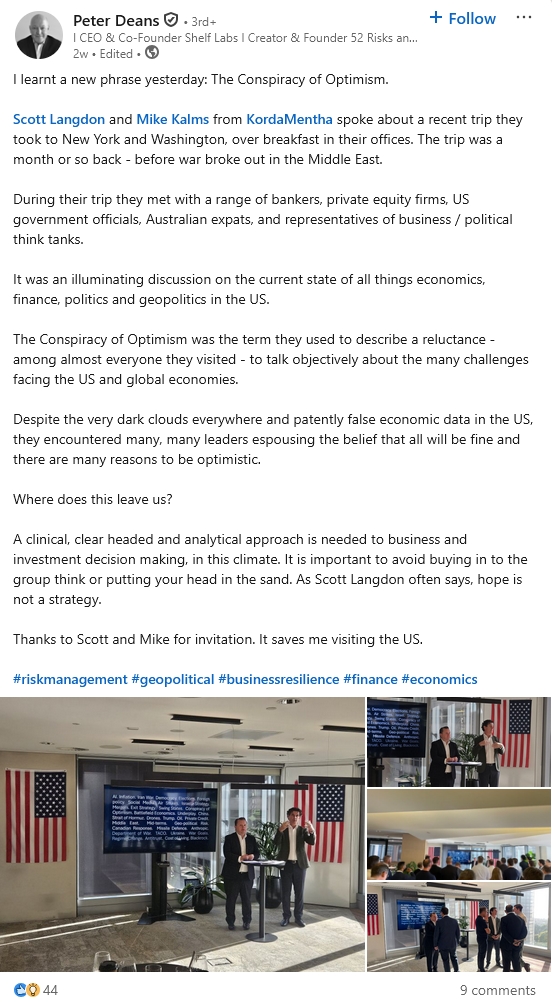
- Geopolitical & Macro Risk Commentary - His most frequent content type. When conflict breaks out in the Middle East, when Wall Street hits record highs, when a typhoon disrupts Asian supply chains, Peter is there within days connecting the event to business risk implications. He treats the news cycle as a content calendar.
- Risk Management Education - Regular posts drawing from the 52 Risks framework, covering everything from cyber risk and people risk to financial leverage and "risk washing." These posts function as previews of longer articles on his website and serve to position him as the authoritative voice on enterprise risk.
- Startup & Fintech Ecosystem - A significant secondary pillar built around his involvement in events like the Singapore FinTech Festival, Hong Kong FinTech Week, and the Tamil Nadu Global Startup Summit. Posts from these events are a mix of trip reports, panel highlights, and community building.
- Personal Milestones & Announcements - New board appointments, the launch of his Gōru startup toolkit book, his role as CEO of Shelf Labs, and his appointment as Singapore FinTech Festival Ambassador all feature. These posts double as credibility signals and keep his network updated on his expanding footprint.
Format & Presentation Style
Posts are predominantly text-based and follow a consistent pattern: a news hook or observation to open, a bridge to the risk management implication, and often a call to engage or a link to a longer piece. He writes in measured, professional prose without much humor or stylistic flair. Post length tends toward medium, rarely short and rarely very long. Images appear mainly in event posts. Hashtag use is minimal and functional.
Engagement Strategy
Peter posts at high frequency. He tags conference organizers, co-founders, and collaborators regularly, and uses his 52 Risks website as an off-platform destination that gives posts a purpose beyond the feed. His content strategy is clearly tied to building the 52 Risks brand rather than just a personal following.
Performance Indicators
Most posts generate modest engagement, typically in the range of low double-digit reactions, consistent with a professional niche audience rather than a broad consumer following. One of his best recent performing posts was his new role announcement at Shelf Labs, which generated 252 reactions and 49 comments, suggesting his personal milestones resonate more broadly than his topic-specific content. His under-8000 follower count reflects his niche positioning.
Overall Strategy Summary
Peter runs a tightly focused content operation built around a single overarching brand: that risk management, done well, is a source of competitive advantage rather than a compliance burden. His LinkedIn presence functions primarily as a distribution channel for the 52 Risks ecosystem and a professional calling card for his advisory and speaking work. The strategy is consistent and disciplined, though the high posting frequency and relatively uniform format mean individual posts don't always stand out. His global travel and event presence give the content variety and freshness that the written commentary alone might lack.
Brent Smart – Chief Marketing Officer, Telstra
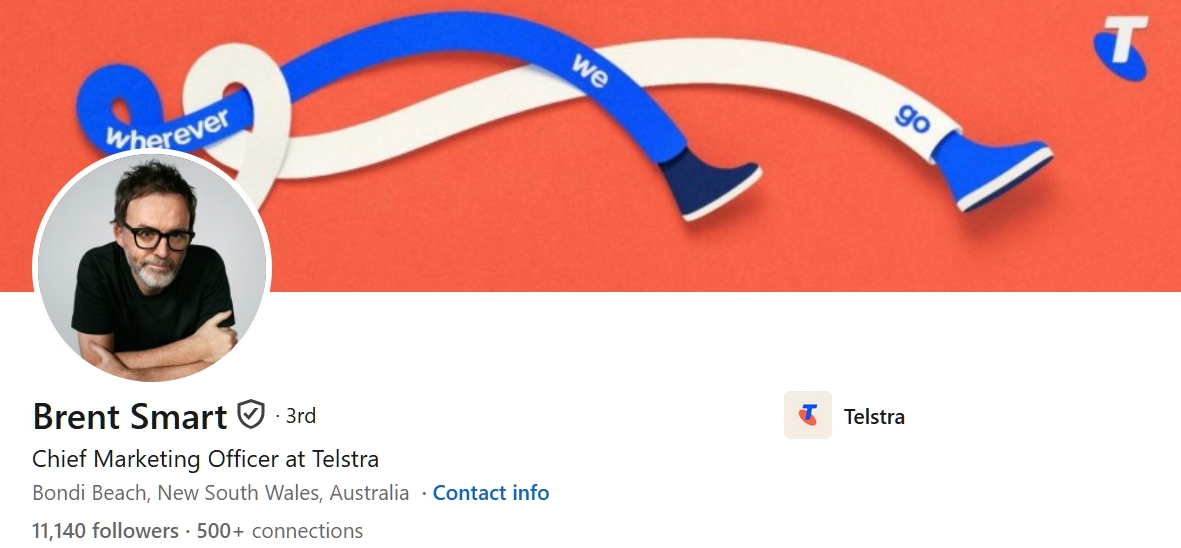
Brent Smart is a creative professional who currently runs marketing for one of Australia's largest telecommunications companies.
After a successful career leading advertising agencies in New York and New Zealand, he moved client-side to transform brands from the inside.
He is known for his belief that safety in business often leads to irrelevance. He champions bold ideas that challenge the status quo.
During his time at IAG, he moved the NRMA brand from the 36th to the 5th strongest brand in Australia. This shift created $400 million in brand value for the organization.
About Telstra
Telstra is Australia’s leading telecommunications and technology company. It provides a wide range of communications services to millions of customers across the country.
The company is currently focused on the rollout of 5G and expanding its digital presence in international markets. It serves as a critical pillar of Australia's digital infrastructure.
LinkedIn Content Strategy Analysis
Who should follow Brent: Marketers, CMOs, creative directors, advertising professionals, and anyone who cares about where creativity meets commercial results.
Core Value Proposition: Brent is Telstra's CMO on a very public mission to prove that creativity is the most powerful business lever in marketing. His feed is a running proof point of that thesis, documenting Telstra's creative journey from award stages to TikTok trends.

Key Themes & Topics
- Creativity as a Business Discipline - His most consistent and passionate thread. He regularly makes the case that creative work and commercial effectiveness are not in tension, they reinforce each other. References to Cannes Lions wins, Effie awards, and the so-called "Leffie" (a Cannes Lion and Effie for the same piece of work) are central to this argument.
- Culture & Craft of Marketing - Posts frequently spotlight the craft elements behind Telstra's work: outdoor advertising philosophy ("great outdoor is about being reductive"), production quality, and the thinking behind specific campaigns like the "Singing Donkey" and "Girl & Ghost" Christmas ads.
- Talent & Team Building - A meaningful portion of his posts are announcements and endorsements of new hires and promotions within his marketing leadership team. He frames Telstra as the most creative marketing team in Australia, and hiring becomes a piece of that story.
- Cultural Moments & Personal Interests - Brent doesn't hide his Liverpool FC fandom, his love for advertising history, or his personal opinions. Posts about attending a live Anfield Wrap podcast recording or watching the TelstraWalk trend spread to the North Korean border are genuinely entertaining.
Format & Presentation Style
Posts are short to medium in length, often conversational, with a distinct voice. He uses short punchy sentences and line breaks for rhythm. Very little formal structure or bullet points. Many posts are amplifications of others' content with a brief but pointed observation of his own added on top. Photo evidence is frequent, whether it's a photo with Sir John Hegarty, an outdoor ad, or a pub celebrating Liverpool's title.
Engagement Strategy
Brent tags agency partners, colleagues, and creators generously, which brings his collaborators' networks into the conversation. He mixes original posts with amplifications of industry content and Telstra campaign milestones. Hashtag use is selective rather than heavy, often campaign-specific (#TelstraWalk, #SecondLifeSounds).
Performance Indicators
Engagement ranges from around 110 to 520+ reactions per post. His most viral posts tend to be cultural moments (the TelstraWalk TikTok trend, the Cannes Grand Prix announcement) or emotionally resonant campaign stories. He has around 11,000 followers, which given his senior role suggests a relatively targeted but engaged professional audience.
Overall Strategy Summary
Brent uses LinkedIn less as a personal brand platform and more as a running public diary of what great marketing leadership looks like in practice. The strategy is coherent: every post either demonstrates, celebrates, or argues for the value of creativity in business. He comes across as a genuine enthusiast rather than a self-promoter, which makes the content more credible and more watchable.
Bel Harper – Chief Product & Marketing Officer, oOh!
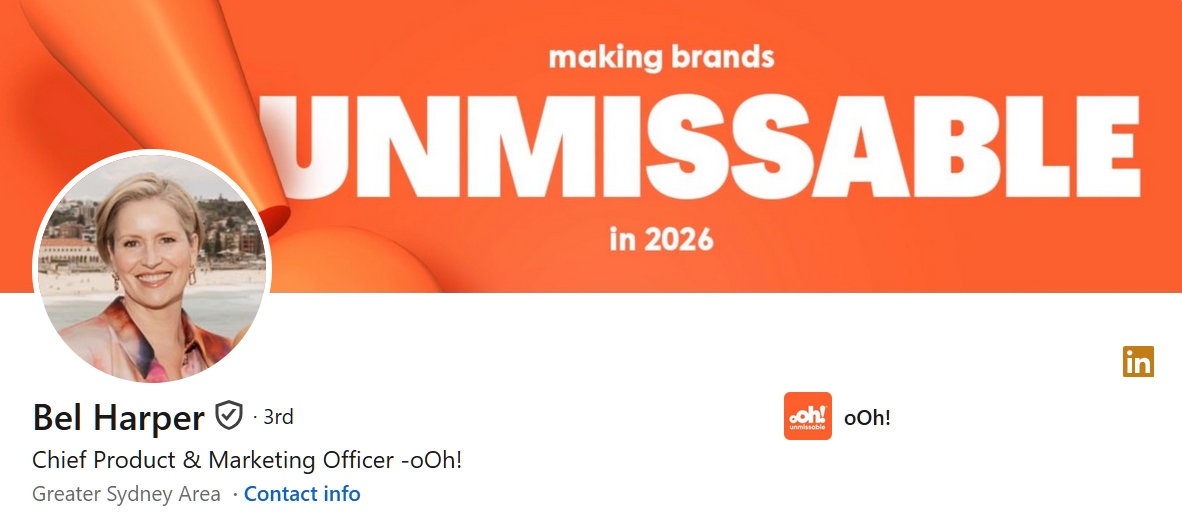
Bel Harper lives at the intersection of product innovation and brand storytelling.
She has been a key driver in moving the out-of-home advertising industry from static paper posters to dynamic, data-driven digital screens.
Her career is a testament to the power of staying curious about how technology changes the way people move through their cities.
Bel approaches marketing from a product perspective. She thinks about the screen itself and the data that triggers the content to ensure the message reaches the right audience at the right time.
About oOh!
oOh!media is the leading out-of-home advertising company in Australia and New Zealand. The industry pulled in $1.45 billion in net revenue in 2025, with digital advertising accounting for 76.6% of that total.
The company reaches over 90% of Australians across 35,000 different locations. It continues to invest in hardware and software to maintain its leadership in the digital media space.
LinkedIn Content Strategy Analysis
Who should follow Bel: Out of Home (OOH) media professionals, marketers and brand leaders evaluating media channels, advertising industry executives, women in media, and anyone interested in the intersection of sales leadership and media strategy.
Core Value Proposition: Bel posts as an enthusiastic insider at oOh!media — a sales and marketing leader who genuinely loves the medium she sells. She combines OOH industry advocacy with authentic people-first content, coming across less like a media executive managing optics and more like someone who actually enjoys the work and the people around her.
Key Themes & Topics
- OOH Industry Advocacy and Education — The backbone of her feed. Bel consistently makes the case for Out of Home as a serious brand-building channel: ROI data from the Mountain Culture Beer Co campaign (an OOH-only strategy that she returned to in multiple posts), the launch of the Melbourne Metro Tunnel advertising assets, the Ashes live-streaming takeover across 4,557 digital screens, and the Transurban motorway tender win. She does not just celebrate the wins — she connects them to a broader argument about why OOH matters in an attention-fragmented world.
- Client and Campaign Celebration — A significant portion of her posts amplify client campaigns and spotlight individual CMOs who took creative risks with the medium. Bradley Firth of Mountain Culture Beer Co appears in at least four posts, each time in service of a different angle on the same campaign's impressive results. This is smart content strategy: it rewards a brave client publicly and makes a persuasive case to every other marketer watching.
- Team and People Recognition — Bel is vocal about the colleagues she respects. She spotlights Melinda D., Jamie Gill, Jenna d'Auvergne, Donna Tauro, and others with genuine warmth, often framing it around what they contribute rather than just congratulating them. These posts consistently earn solid engagement and reinforce her identity as a leader who champions her team rather than centering herself.
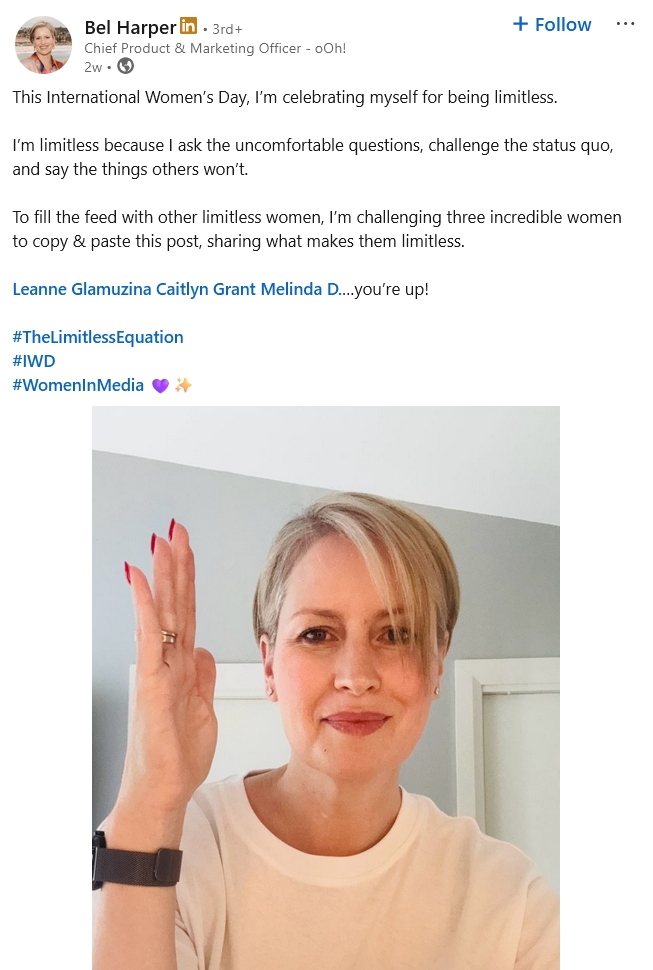
- Women in Leadership and Mentorship — A personal thread running through the feed. Posts on the IMAA mentoring speed-dating session, the IWD "Limitless" chain post, the B&T "Best of the Best Mentors" recognition, and the "It Takes a Village" podcast about career and parenthood all signal that she is actively invested in supporting women in the media industry, not just participating in the conversation.
- Industry Events and Appearances — Conference panels, the Mumbrella Compass lineup, the Powering DOOH event, the Bondi Icebergs summer launch — Bel documents her industry presence without making it feel like a highlights reel. The posts are short, warm, and name the people she shares the stage with.
Format and Presentation Style
Bel writes short and punchy. Most posts are under 100 words, sometimes considerably less. She leads with the point — a bold claim, a celebration, a quick observation — and lets a linked article or oOh! company post carry the detail. This brevity is deliberate and suits her voice: direct, energetic, affectionate. She uses emojis comfortably without overdoing it. Images tend to be event photography or oOh! campaign visuals, which are consistently high quality. Hashtag use is minimal and inconsistent, which is the one obvious gap in her approach.
Engagement Strategy
Bel's content breaks into two clearly distinct tiers. Personal-voice posts — the IWD "limitless" chain (150 likes, 13 comments), the sales team of the year win (279 likes, 25 comments), the "To All The Working Mums Faking Normal" B&T piece (106 likes, 15 comments), the Transurban tender win (110 likes, 4 comments) — generate her strongest numbers by a significant margin. OOH company content that she shares with a brief endorsement sits in the 20-50 likes range. The gap is consistent and telling: her audience follows Bel, and they respond when they hear her actual voice, not when she amplifies someone else's.
Performance Indicators
Across 40 posts, her average sits around 65 likes per post, with one outlier at 279 (the sales team award) and several strong performers in the 100-150 range. One of her best recent performing posts was the sales team of the year recognition — it combined genuine pride, leadership transparency (acknowledging the team they were building from scratch), and a clear narrative arc, which is exactly the formula that earns strong comment counts in addition to likes. Her mentorship and women-in-media content consistently generates comments, suggesting those posts open conversations rather than just collecting reactions.
Overall Strategy Summary
Bel is building a profile as a media industry leader with commercial credibility and genuine human warmth — someone worth knowing rather than simply following. The OOH advocacy work gives her professional authority. The people-first content gives her likability. But the most interesting opportunity in her feed is the one she has not yet fully leaned into: her personal voice on the harder topics. The working mothers piece, the IWD post, the sales team win — these show a leader with perspective and backbone. More of that, and less pure company content amplification, would significantly strengthen an already engaging presence.
Michelle Klein – Chief Growth & Marketing Officer, Westpac}
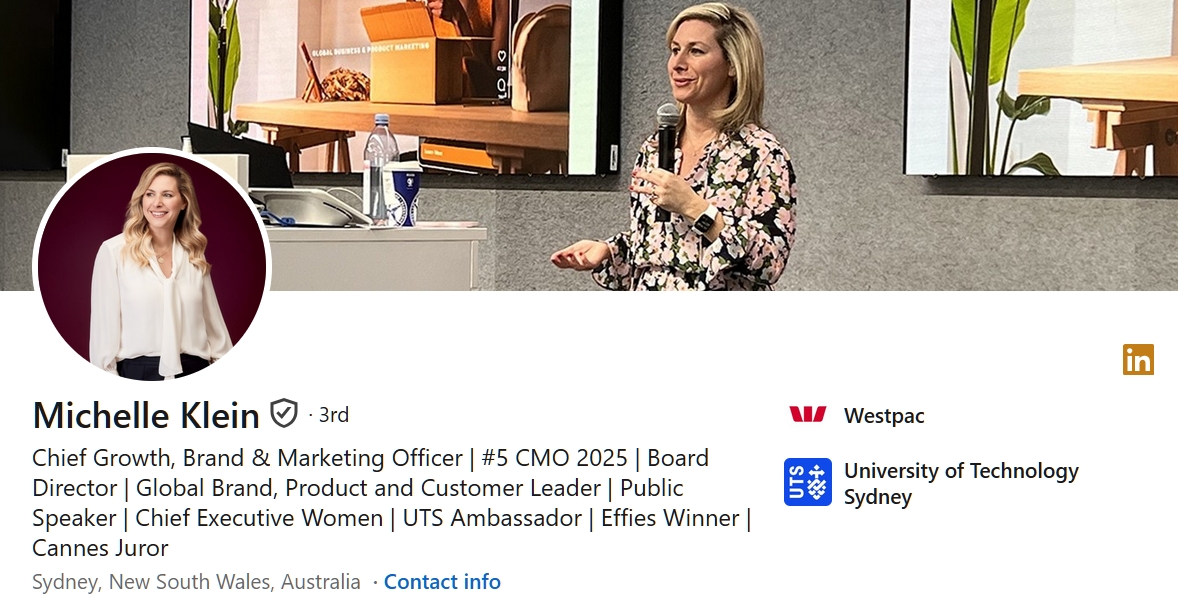
Michelle Klein is a global marketing powerhouse who returned to Australia after a decade at Meta in the United States.
She is a three-time Effie Award winner who has spent her career figuring out how to connect people through technology.
Now at Westpac, she is tasked with driving growth for a 200-year-old brand in a digital-first world.
She brings a Silicon Valley perspective to the Australian banking sector. Her experience managing global business marketing for platforms with billions of users gives her a unique advantage in understanding digital scale and customer engagement.
About Westpac
Westpac is one of the four major banks in Australia. The company is currently doubling down on its AI and digital firepower to improve customer experiences.
The bank recently appointed new leadership to oversee data and customer brand strategy as they celebrate a 208-year history. It remains a dominant force in the Australian financial landscape.
LinkedIn Content Strategy Analysis
Who should follow Michelle: CMOs and senior marketers, brand strategists, financial services executives, women in leadership, and marketing professionals interested in how major brands show up in culture.
Core Value Proposition: Michelle posts as a senior marketing leader who believes brand is a business asset, not a communication afterthought. She documents her work at Westpac in real time — the campaigns, the partnerships, the team — with the confidence of someone who knows exactly what she is building and why.
Key Themes & Topics
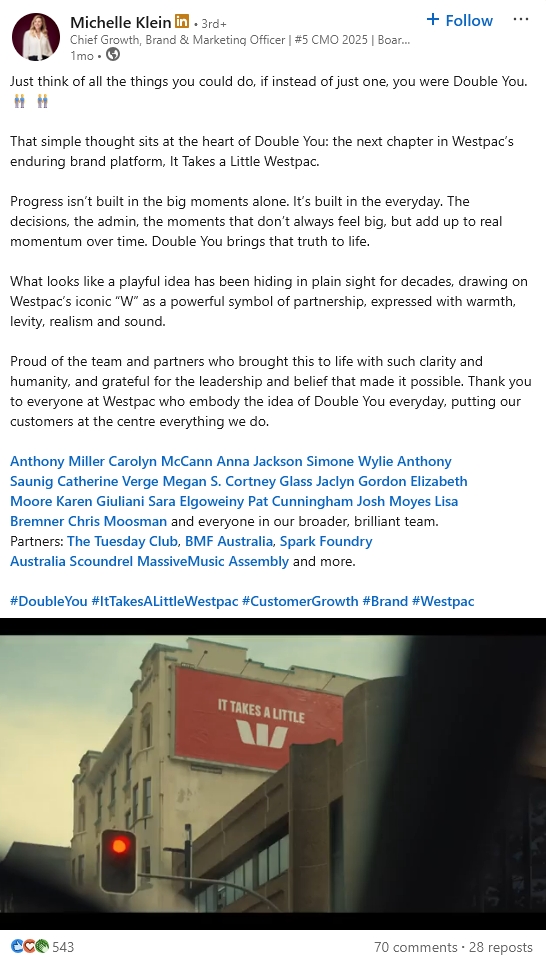
- Westpac Brand and Campaign Work — The dominant thread. Michelle posts about every meaningful Westpac brand moment: the launch of the "Double You" platform, the Cricket Australia partnership activation, the first-ever cricket campaign featuring Pat Cummins and Alyssa Healy, the Bolte Bridge domination in Melbourne, the AFL sponsorship at Adelaide Oval. These are not corporate announcements — they read as genuine professional pride. She treats the work as worth showing off, and that distinction matters.
- Marketing Philosophy and Brand Thinking — A smaller but high-performing thread. Posts that zoom out from the specific campaign to explore the thinking behind it ("Attention is easy. Memory is the advantage") earn strong engagement. Michelle draws on her career across NRMA Insurance, IAG, and now Westpac to articulate what makes brand investment worthwhile, particularly in an era when short-termism dominates marketing conversations.
- Leadership and Team Culture — She regularly spotlights her team: announcing new hires, celebrating team events at the Carla Zampatti Salon, sharing the farewell video her IAG team made for her. This is deliberate positioning — she wants to be seen as a leader who elevates people, not just someone who signs off on campaigns.
- Industry Recognition and External Positioning — Her #5 CMO 2025 ranking, her ADMA Advisory Committee appointment, award shortlists, and media appearances feature regularly. Rather than posting them as flex moments, she usually frames them around what the industry conversation means to her.
- Purpose and Community — Posts on NRMA Insurance's disaster relief response (Cyclone Alfred), the Beyond 3% First Nations media commitment, and Westpac's new literacy and numeracy philanthropy program show that she connects commercial brand work to social impact. These posts earn solid engagement and signal that she sees brand leadership as something with stakes beyond market share.
Format and Presentation Style
Michelle writes with energy and warmth, in a style that is polished but not stiff. Posts are medium-length — rarely more than 250 words — and often open with a short, punchy line before developing into a brief narrative or reflection. She uses emojis sparingly and well. Images are campaign-quality: stadium shots, OOH photography, event pictures that show genuine presence. Hashtag use is targeted: #Westpac, #ItTakesALittleWestpac, #marketing, #leadership, #Brand. She does not over-tag.
Engagement Strategy
With around 7,300 followers, Michelle consistently generates disproportionately high engagement. Her top posts — the Westpac announcement (559 likes, 67 comments), the "Double You" campaign launch (543 likes, 70 comments), and the cricket campaign debut (407 likes, 65 comments) — reflect an audience that follows her career closely and responds to moments of genuine professional pride. The comment-to-like ratio on her best posts is notably high, suggesting real conversations rather than passive scrolling.
Performance Indicators
Post performance splits clearly into two tiers. Brand milestone posts — new roles, campaign launches, major sponsorship activations — routinely hit 200-550+ reactions with strong comment counts. Regular content (industry events, quick observations, team shoutouts) sits in the 50-150 range. One of her best recent performing posts was the "Double You" campaign launch writeup, which clearly captured both her network's genuine interest in the campaign thinking and their affection for her as a professional.
Overall Strategy Summary
Michelle is doing something relatively rare on LinkedIn: treating her personal profile as a live record of serious brand leadership in action. She is not performing thought leadership from a distance — she is showing what it actually looks like to run marketing at scale for one of Australia's oldest institutions. The result is a feed that functions as both a portfolio and a proof of conviction. Her audience follows because they trust her judgement, and every campaign post reinforces that trust. The opportunity, if there is one, is in more of the zoomed-out marketing philosophy content — those posts outperform on comments, suggesting they drive the kind of debate her audience finds genuinely useful.
Kellie Hush – CEO, Australian Fashion Week
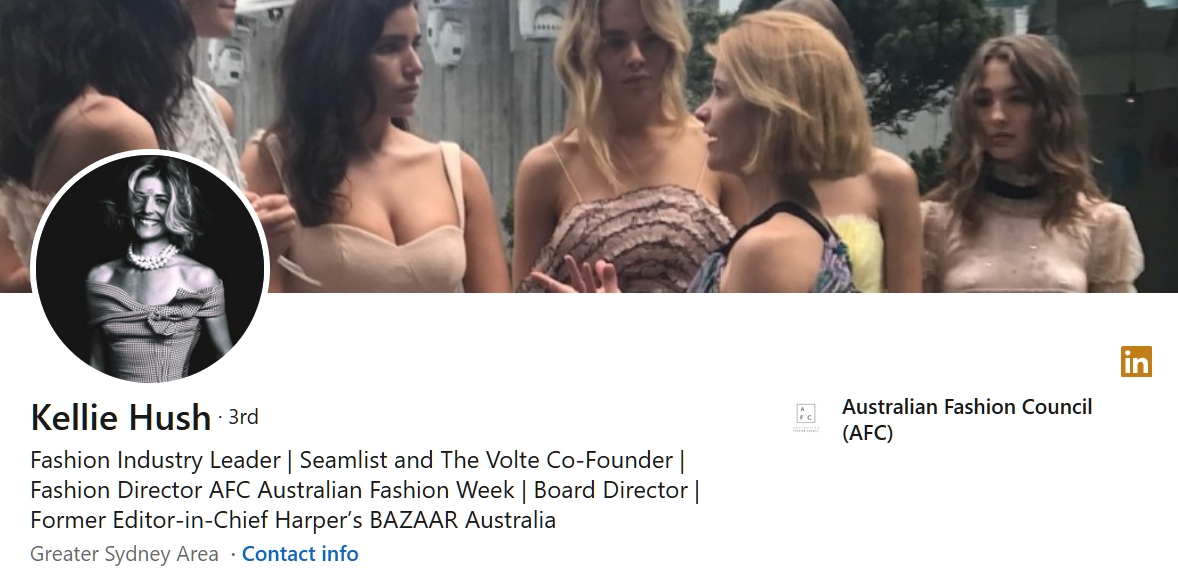
Kellie Hush has spent 25 years as one of the most influential figures in the Australian fashion industry.
From her days as the Editor-in-Chief of Harper’s BAZAAR to her current role leading the country's premier fashion event, she has always been a champion for emerging talent.
Kellie is now focused on making the fashion industry more sustainable and circular.
She is a rare executive who can speak to both the art and the commerce of the industry. She understands the creative needs of a designer and the operational needs of a CEO.
About Australian Fashion Council
The Australian Fashion Council is a non-profit organization that supports the growth and evolution of the national fashion industry.
Kellie Hush was appointed as the CEO of Australian Fashion Week 2025 to deliver an event that supports industry evolution and circular fashion. The organization works to position Australian fashion on the global stage.
🔗 Visit Australian Fashion Council
LinkedIn Content Strategy Analysis
Who should follow Kellie: Fashion industry professionals, circular economy advocates, startup founders, aspiring female leaders, sustainability practitioners, and anyone navigating career reinvention across industries.
Core Value Proposition: Kellie positions herself at the intersection of three things most people keep separate — fashion, technology, and leadership. With a career spanning Harper's BAZAAR Editor-in-Chief, co-founder of The Volte, and CEO of Australian Fashion Week, she has earned the right to speak on all three, and she does so with candour rather than polish.
Key Themes & Topics
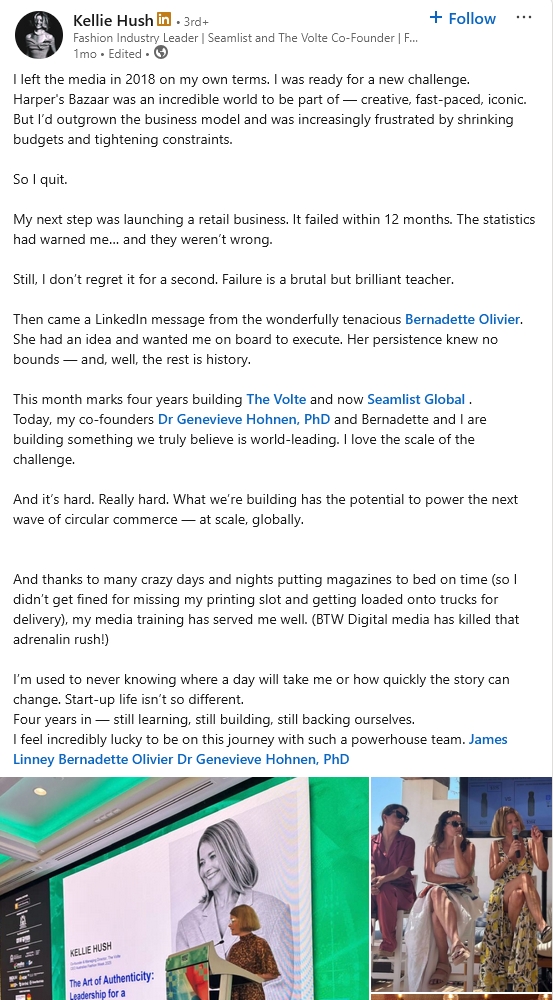
- Leadership and Career Reinvention — The dominant thread. Kellie returns repeatedly to what leadership actually looks like away from the highlights: the setbacks, the reinventions, the unglamorous consistency. Her most viral posts are almost always in this register. One of her best recent performing posts opened with "I left the media in 2018 on my own terms" and walked through quitting Harper's Bazaar, the failures that followed, and what it eventually built into — earning 317 likes and 22 comments. These posts are personal, direct, and devoid of corporate language.
- The Volte and Circular Fashion — As co-founder and Chief Brand & Strategy Officer of The Volte, she posts about the business milestone-by-milestone: the eBay partnership, the UK launch, the Cotton On collaboration, the UTS research study on fashion rental's environmental impact. These posts tend to read as genuine excitement rather than marketing copy, which gives them credibility.
- Australian Fashion Week — As CEO of AFW, she uses LinkedIn to communicate major announcements (the MCA partnership for AFW 2026, the 2025 wrap-up), reflect on what the week means to Australian designers, and amplify the broader creative community behind the event. The tone here is more ceremonial — proud and grateful — than her leadership posts.
- Sustainability and Industry Change — Posts on circular fashion legislation, peer-to-peer rental research, and the business case for sustainable fashion speak to an audience that wants evidence alongside advocacy. She is comfortable citing data and positioning The Volte inside the wider systemic shift.
- Speaking Engagements and Media — A consistent thread of conference keynotes, podcast appearances, and media interviews serves both as proof of profile and as content in its own right. Rather than just posting "I spoke at X," she usually extracts the core message from the talk and shares it as a standalone idea.
Format and Presentation Style
Kellie's best posts read like personal essays in miniature — she opens with something direct or unexpected, builds quickly, and closes with a perspective rather than a call to action. The posts that perform best tend to be 200-400 words. She avoids bullet points in personal posts entirely, reserving them for announcements and event logistics. Imagery is well-chosen: runway shots, campaign visuals, event photography that reflects the quality of the worlds she moves through. Hashtag use is light and purposeful — #TheVolte, #Leadership, #Resilience, #Innovation — with no over-tagging.
Engagement Strategy
Kellie's content performance is notably top-heavy. Her personal voice posts on leadership, career courage, and women in business consistently hit 150-300+ reactions, while industry updates and speaking announcements sit in the 40-90 range. This gap signals clearly where her audience follows her: they are interested in her, not just in fashion news. Posts where she reveals something uncomfortable or counterintuitive — the bullying she experienced at school, the very public failures, the decision to walk away from a prestigious masthead — earn the strongest response. Her audience rewards honesty.
Performance Indicators
Engagement averages around 100 likes per post across 33 posts, which is strong relative to audience size. One of her best recent performing posts — the career reinvention essay about leaving Harper's Bazaar — topped 317 likes and 22 comments. The AFW 2025 reflection hit 228 likes and 28 comments. The AFW 2026 MCA announcement earned 236 likes and 8 comments. Notably, even her straightforward company news posts clear 50-100 reactions, suggesting her audience is genuinely engaged rather than algorithmically inflated.
Overall Strategy Summary
Kellie is building a dual-track reputation: fashion industry authority and leadership voice for women reinventing themselves. These two tracks complement each other more than they compete. The Volte gives her a live business story to tell. AFW gives her institutional credibility. Her personal posts give her something neither of those can: the kind of trust that comes from telling the truth about how hard it actually is. The gap between her best-performing content (personal, reflective) and her weaker content (pure announcements) points to an opportunity to apply her personal voice more consistently across everything she posts.
Kit McMahon – CEO, Women's Health In The South East
Kit McMahon is a passionate advocate for gender equality who has spent two decades in the non-profit and education sectors.
She has dedicated her career to ensuring that the voices of marginalized communities are heard at the highest levels of government.
Kit believes that collaboration is the only way to drive real social change in the community.
She focuses on the technical side of policy. She discusses impact assessments and action plans to give other leaders a roadmap for implementing equality in their own organizations.
About WHISE
WHISE is a regional health promotion agency located in the south-east of Melbourne. Kit has led efforts to implement gender equality action plans across local governments and tourism agencies.
The organization works to improve the health and well-being of women through advocacy and education. It remains a key voice in the discussion of gender equity in Australia.
LinkedIn Content Strategy Analysis
Who should follow Kit: Social sector leaders, gender equity advocates, VET and workforce policy professionals, public health practitioners, community health workers, and anyone working in or adjacent to the prevention of violence against women.
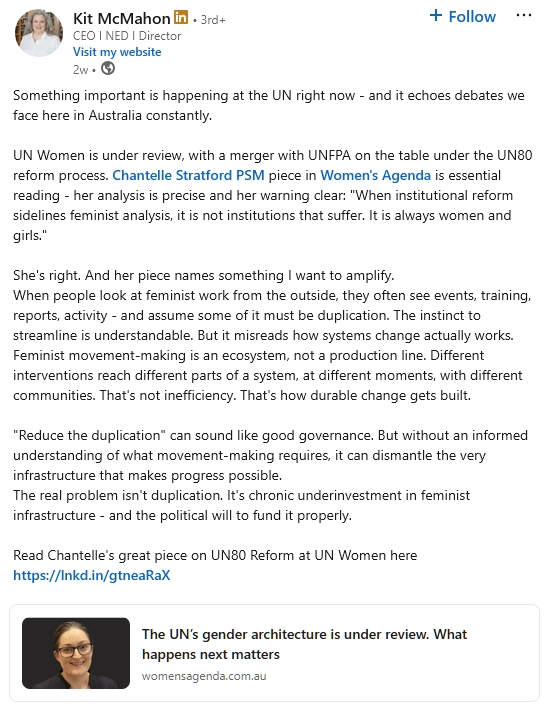
Core Value Proposition: Kit posts as a mission-driven CEO — not as a personal brand. Her content is almost entirely in service of WHISE (Women's Health in the South East) and the broader women's health and gender equity sector in Victoria. She brings warmth, directness, and genuine conviction to issues that many organizations communicate about dryly.
Key Themes & Topics
- Prevention of Violence Against Women — The most consistent thread across her feed. Kit champions primary prevention work, spotlights partner organizations, shares campaign milestones from 16 Days of Activism, and links the day-to-day work of WHISE to national and international policy conversations. The framing is always sector-wide, not just organizational.
- Gender Equity and Intersectionality — Kit regularly engages with WGEA data, intersectionality in leadership, the gender pay gap, and systemic inequity in the VET sector. Posts often respond to external reports, political developments, or sector research, and she adds her own brief commentary rather than simply forwarding the link.
- Women's Health and Reproductive Rights — Menopause, endometriosis, reproductive health access, and the gender pain gap all feature, with posts ranging from community program updates to sharp reactions to controversial political claims (her highest-performing post shared RANZCOG's rebuttal of the Trump administration's paracetamol/autism assertions, earning 868 reactions through its credibility as a science-based statement in a heated moment).
- VET, Skills, and Gender — A less obvious but recurring theme: Kit cares deeply about vocational education and gender equity within the skills system, particularly for women from multicultural backgrounds. Posts in this vein tend to feel more personal than the WHISE-branded content.
- Sector Community and Solidarity — Kit regularly celebrates partners, attends events, and names individuals by name across the sector. Her personal posts from dinners, conferences, and community sessions communicate that she is a genuine participant in this world, not a figurehead.
Format and Presentation Style
Kit's posts fall into two clear camps. Organizational content — announcements, program updates, event invitations — is clean and factual, with bullet points for event logistics and clear hashtags. Her personal posts are looser, more conversational, even idiosyncratic (the end-of-year "farknarkling" post, which earned 107 reactions, is a good example of how her voice breaks through when she lets it). She writes with energy and affection for the sector and the people in it. Hashtag use is purposeful: #GenderEquality, #ThisIsPrevention, #BalanceTheScales, #WHISE, #WomensHealth and campaign-specific tags appear consistently.
Engagement Strategy
Much of Kit's feed is curated amplification — sharing content from partner organizations like Safe and Equal, RANZCOG, Transgender Victoria, and others, with a short endorsement from her. This reflects the nature of her role: advocacy is relational work, and she treats LinkedIn as a place to build coalitions, not an audience. Her own personal posts, however, tend to outperform the pure amplification content on engagement, suggesting her voice resonates when it is most visible. One of her best recent performing posts was a year-end personal note that had nothing programmatic about it at all — just a human being calling time on a hard year.
Performance Indicators
Engagement varies widely. Posts tied to major external moments (IWD, 16 Days of Activism, politically charged news) reach 50-100+ reactions. Organizational program updates tend to land in the 10-30 range. One of her best recent performing posts was the RANZCOG paracetamol/autism statement, which peaked at 868 reactions — not because of Kit's framing, but because she put credible science into a heated conversation at exactly the right moment. Her personal voice posts (the year-end sign-off, IWD commentary, event reflections) consistently outperform purely informational posts.
Overall Strategy Summary
Kit's LinkedIn presence is sector advocacy, not personal brand-building. She shows up with consistency and genuine care, and the cumulative effect is that she reads as someone who means it — not someone managing perception. The occasional glimpse of her personality (the warmth, the wit, the unguarded end-of-year posts) makes her more credible, not less professional. If she deliberately brought more of that personal voice into her regular posting rhythm, her engagement would likely be stronger still.
Michelle Ockers – Chief Learning Strategist, Learning Uncut
Michelle Ockers is on a mission to modernize the way we learn at work.
She is an award-winning strategist who believes that traditional training methods are often ineffective in the modern workplace.
Michelle helps organizations build learning cultures where people can thrive through high-impact strategies.
She is a practitioner who shares the reality of what works and what fails in the field of learning and development. Her focus on case studies makes her advice immediately actionable for her global audience.
About Learning Uncut
Learning Uncut is a strategy firm and a popular podcast that helps organizations maximize the potential of their people. They recently launched the L&D Strategy Accelerator.
The accelerator is a six-month program designed to help leaders co-design and implement workplace learning plans. The firm continues to lead the conversation on modern workplace learning through its various platforms.
LinkedIn Content Strategy Analysis
Who should follow Michelle: L&D professionals, learning strategists, HR leaders, CLOs, and anyone responsible for building learning capability inside organizations.
Core Value Proposition: Michelle positions herself as a practitioner-author at the center of the L&D profession — the Chief Learning Strategist at Learning Uncut and co-author of The L&D Leader, she connects strategic thinking with real-world application, and brings her community along for the ride.
Key Themes & Topics
- L&D Strategy and Practice — Her dominant thread. Posts explore how learning teams can move from order-takers to strategic business partners, grounded in real client case studies from organizations like National Australia Bank, Grampians Health, and Versent. She doesn't deal in theory for its own sake; there is always a practical takeaway.
- The Learning Uncut Podcast — A significant portion of her posts promote new episodes, each featuring a guest sharing how they tackled a specific L&D challenge. These posts are well-structured: they frame the episode's key question, share two or three things listeners will take away, and include a direct link. The podcast is the engine of her content machine.
- The L&D Leader Book — The book launch has been a steady content thread. Posts range from the emotional (holding the book for the first time) to the promotional (co-authored articles, webinars tied to the book's frameworks like the BOLD Compass).
- Community and Collaboration — Michelle actively centers the L&D community in her posts. The "Two Michelles" collaboration with Michelle Parry-Slater, community webinars, and the "works out loud" hashtag (#MichelleWorksOutLoud) all signal that her practice is deliberately public and participatory.
- Personal Reflection — Occasional posts show the human behind the professional brand: what it is like running a small business, collaborating after years of working solo, and sharing honest observations about the profession's ongoing struggles (like permission to learn still being a genuine barrier in many workplaces).
Format and Presentation Style
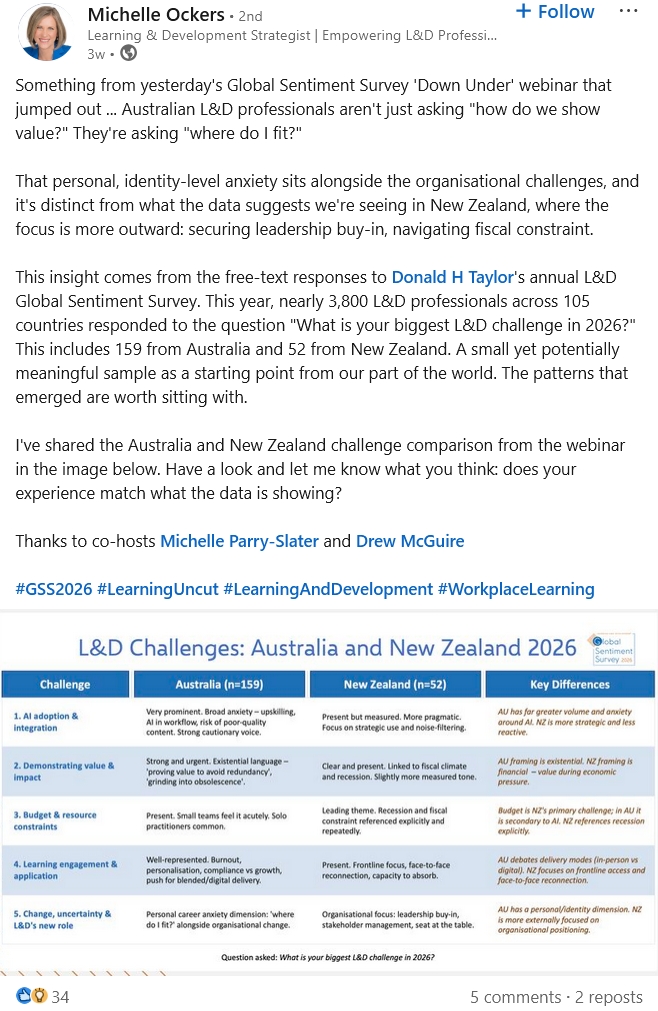
Michelle writes in long-form prose. Posts tend to be structured narratives: she opens with a question or observation, develops it with evidence from a conversation, a client story, or a webinar, and closes with a clear call to action. There are no bullet-point lists or numbered frameworks — it reads like someone thinking out loud rather than presenting a deck. She uses hashtags consistently and purposefully, with a tight cluster around #LearningAndDevelopment, #LearningUncut, #WorkplaceLearning, and #LearningStrategy.
Engagement Strategy
Michelle's follower count sits at just over 12,700, and posts typically earn between 10 and 100 likes, with occasional spikes to 160-200 on milestone posts. Her engagement is notably comment-rich relative to the size of her audience — 15 to 66 comments on top posts — which suggests a highly engaged, specialist following rather than a broad general one. She drives traffic to the Learning Uncut podcast and to her newsletter (Transform & Thrive) as consistent off-platform destinations.
Performance Indicators
Posts tied to personal milestones (receiving the book, connecting with a collaborator in person, hosting a sold-out breakfast event) generate her strongest engagement, as do posts framed around community learning — the webinar recap post earned 28 likes and 7 comments, while the book arrival post hit 203 likes and 66 comments. Podcast promotion posts are steady but lower-engagement by comparison.
Overall Strategy Summary
Michelle is building a long-term practitioner brand in a tight professional niche. She is not trying to go viral — she is trying to go deep. Her content rewards the L&D community with substance, positions Learning Uncut as the authoritative podcast in the space, and keeps the book and its frameworks circulating without feeling like a sales exercise. The personal transparency — including what it is like to grow a small business — adds credibility that purely promotional content cannot buy.